Creating a website requires a deep understanding of the user’s objectives, goals, and requirements. Whether you’re redesigning an existing site or starting from scratch, here are 20 crucial questions to guide you.
Objectives and Goals Before diving into specific questions, it’s essential to understand the broader objectives and goals behind creating or redesigning a website. These include:
Identifying the Target Audience: Who are you trying to reach?
Clarifying the Main Objective: What primary action do you want visitors to take?
Measuring Success: How will you determine if your website is successful? If you would like some additional website goals for a small business.
20 Questions to Ask When Designing or Developing a Website
Purpose: What’s the primary purpose of the website? Why: The core reason for creating the website determines every subsequent decision. Knowing if it’s e-commerce, informational, or a personal blog changes design choices, functionalities, and user experience.
Audience: Who are your target users? Why: A website should be tailored to its audience. Understanding the demographics and interests of potential visitors ensures content and design appeal directly to them, increasing engagement and conversion rates.
Content: What kind of content will your site feature? Why: Different content types (text, video, images) require different design and functional elements. It also affects website speed, storage needs, and user interactions.
Design Preferences: Are there existing websites or specific design elements you’d like to incorporate? Why: Having a clear idea or reference helps designers understand aesthetic preferences, saving time and ensuring client satisfaction.
Branding: Do you have existing brand guidelines or colors? Why: Brand consistency across all platforms enhances recognition and trust. Adhering to existing guidelines ensures the website aligns with other brand materials.
Functionality: Are there specific functionalities you need? Why: Website functionality should align with its purpose. An e-commerce site will need shopping cart functions, while a portfolio might need a gallery.
Mobile: How important is mobile optimization? Why: With a significant portion of users accessing websites via mobile devices, ensuring a site is mobile-friendly can vastly affect user experience and search rankings.
SEO: How important is search engine optimization? Why: SEO ensures the website can be found easily on search engines, driving organic traffic. Knowing its importance can affect content, structure, and backend development.
Integration: Do you need your site to integrate with other tools? Why: Some businesses rely heavily on CRM tools, email marketing, or other third-party platforms. Seamless integration can automate processes and enhance user experience.
Maintenance: Who will maintain the website after launch? Why: Websites require regular updates and maintenance. Knowing who’s responsible post-launch ensures continuity and long-term functionality.
Scalability: Do you anticipate scaling up in the future? Why: If there’s potential for business or content growth, the site’s infrastructure should be built to accommodate that, ensuring longevity and cost-efficiency.
Timeline: By when do you need the website completed? Why: Setting clear deadlines helps in project management, andallocation of resources, and ensures the project stays on track.
Budget: What is your budget? Why: Budget dictates many factors, from design complexity to functionalities. Being clear upfront helps in setting realistic expectations.
Accessibility: Is accessibility important? Why: Ensuring a site is accessible to all, including those with disabilities, is not only ethical but can also be a legal requirement in many places.
Conversion: What actions do you want users to take? Why: Knowing desired user actions (like sign-ups or purchases) allows for optimization of design and functionalities to drive those specific actions.
Feedback: How will you gather user feedback? Why: Feedback is invaluable for ongoing improvement. Planning for feedback collection ensures the website remains user-centric.
Hosting and Domain: Do you have a domain and hosting provider? Why: This affects website speed, security, and other technical aspects. Knowing this upfront can influence development choices.
Security: Are there specific security concerns? Why: Especially critical for sites handling sensitive information. Ensuring robust security protocols protects both the business and its users.
Analytics: How will you track website performance? Why: Analytics provide insights into user behavior, site performance, and areas of improvement. Setting this up from the start ensures data-driven decision-making.
Communication: How often would you like updates? Why: Regular communication ensures everyone’s on the same page, reduces misunderstandings and ensures the project aligns with expectations.
In essence, each question aims to clarify and streamline the website creation process, ensuring the end product aligns perfectly with the business’s needs and user expectations. In conclusion, by asking these questions, it will influence your website design and functionality understanding the objectives and goals for a website is paramount. By asking these 20 questions, you and any designers and developers can ensure they’re on the right track to creating a site that not only looks great but also serves its intended purpose efficiently.
In today’s digital age, having a website is essential for any small business. Not only does it provide a platform for your customers to find you, but it also plays a crucial role in brand recognition, credibility, and growth. Here are the top 10 objectives and goals every small business website should aim to achieve.
Clear Branding Explanation: A clear and consistent branding across your website can make your business more recognizable. This includes your logo, color scheme, and the general tone of your content.
Benefits: Consistency in branding can build trust with your audience. It makes your business appear more professional and establishes a solid identity in a crowded market.
User-Friendly Design Explanation: A user-friendly design ensures that visitors can easily navigate your site, find information quickly, and perform desired actions without friction.
Benefits: A well-structured and intuitive design enhances user experience. This not only ensures visitors stay longer on your site but also increases the chances of them returning.
Mobile Optimization Explanation: With a majority of users accessing websites from mobile devices, your site needs to be mobile-friendly, ensuring it looks and functions well on smartphones and tablets.
Benefits: A mobile-optimized site can boost search engine rankings, improve user experience, and widen your reach.
Engaging Content Explanation: Your content, from blog posts to product descriptions, should be valuable, relevant, and engaging.
Benefits: Engaging content can keep visitors on your site longer, establish your business as an industry leader, and encourage social sharing.
Call-to-Action (CTA) Elements Explanation: CTAs are prompts that encourage users to take a specific action, be it signing up for a newsletter, making a purchase, or contacting you.
Benefits: Effective CTAs can drive conversions, gather valuable customer data, and guide users smoothly through your sales funnel.
Search Engine Optimization (SEO) Explanation: SEO involves optimizing your site to rank higher in search engine results, making it easier for potential customers to find you.
Benefits: Improved search rankings mean more organic traffic, greater brand visibility, and a higher chance of conversions.
Fast Loading Times Explanation: In the age of instant gratification, a slow-loading website can deter visitors. Ensuring that your website loads swiftly is crucial.
Benefits: Faster loading times improve user experience, reduce bounce rates, and can positively affect SEO rankings.
Secure and Accessible Website Explanation: Security should be a top priority, ensuring that your site is safe from cyber threats. Additionally, ensuring your website is accessible to people with disabilities widens your audience and is a step towards inclusivity.
Benefits: A secure site builds trust among visitors, and being accessible can boost your reputation and customer base.
Social Media Integration Explanation: Integrating social media links or widgets on your website allows users to easily connect with your social platforms.
Benefits: This enhances customer engagement, drives traffic from social media channels, and builds a cohesive online presence.
Regular Updates and Maintenance Explanation: The digital world is always evolving. Regularly updating your website content and ensuring its smooth operation is key.
Benefits: An updated site is more relevant to visitors, showcases your business’s growth and adaptability, and can address potential security vulnerabilities.
Conclusion:
Your website is often the first interaction potential customers have with your brand. By prioritizing these 10 objectives, you can ensure that your site not only looks professional but also functions effectively, fostering growth and success for your small business. Remember, a good website is an investment that can yield significant returns when done right.
Still unsure if your website is hitting all these targets and more?
12 Essential Digital Marketing Tactics for Small Businesses in 2023
Digital Marketing is a game-changer for small businesses.
With the right strategies, it allows you to compete effectively with larger firms, build a global audience, and foster a closer relationship with your customers. The big question is, how can small businesses make the most of digital marketing? Below, we outline 12 essential tactics to consider in your digital marketing plan.
Set Clear Marketing Goals First things first, define what you want to achieve with digital marketing. Are you looking to increase brand awareness, boost sales, or perhaps improve customer loyalty? Clear goals will guide your strategies and allow you to measure your progress effectively.
Know Your Audience To engage your audience effectively, you need to understand their interests, pain points, and how they like to consume content. Customer surveys, social media insights, and Google Analytics are just some tools you can use to understand your audience better.
Optimize Your Website for SEO Search Engine Optimization (SEO) is the process of improving your website so that it ranks higher on search engine result pages. This boosts organic traffic, making it easier for potential customers to find you. Consider on-page SEO tactics like optimizing your website content and internal links, as well as off-page strategies like building high-quality backlinks and increasing traffic flow.
Leverage Content Marketing Content marketing involves creating and sharing valuable content that attracts, informs, and engages your audience. This could be blog posts, eBooks, infographics, or videos. A strong content marketing strategy can boost your SEO, generate leads, and establish your brand as an industry authority.
Invest in Email Marketing Despite being one of the oldest digital marketing tactics, email marketing remains extremely highly effective. Collect emails from visitors to your website and nurture these leads with regular, value-rich content. Personalization and automation can significantly enhance your email marketing campaigns.
Utilize Social Media Marketing Today, social media is a powerful tool for building brand awareness, promoting products, and interacting with your customers. Choose platforms that align with your target audience, and share engaging, relevant content regularly. Live videos, stories, and user-generated content can significantly enhance your social media strategy.
Implement Pay-Per-Click Advertising Pay-Per-Click (PPC) advertising, like Google Ads, can provide a significant boost to your online visibility. You only pay when someone clicks on your ad, making this an effective and budget-friendly marketing tactic. However, research the cost-effectiveness of this against your cost of sale profitability.
Engage in Local SEO For businesses that serve specific geographic areas, local SEO is essential. Make sure your business is listed in online directories, and optimize your website for local search terms. Also, encourage satisfied customers to leave reviews on Google and other review platforms to boost your local credibility.
Leverage Influencer Marketing By partnering with influencers or networking partners in your niche, you can reach a broader audience. Micro-influencers, although they have fewer followers, often have a more engaged audience, making them a cost-effective option for small businesses.
Harness the Power of Video Marketing Youtube is still one of the most searched platforms and of course, is owned by Google. Video content is highly engaging and favored by algorithms on platforms like Facebook and Instagram. Consider creating product demos, tutorials, behind-the-scenes videos, and customer testimonials to connect with your audience.
Optimize for Mobile More than half of all internet traffic comes from mobile devices. Ensure your website is mobile-friendly, and consider using mobile-specific tactics like SMS marketing and mobile apps.
Monitor and Adjust Your Strategies Lastly, digital marketing as with all marketing is not a set-it-and-forget-it endeavor. Use tools like Google Analytics to monitor your campaigns’ performance and adjust your strategies as needed.
Digital marketing can seem overwhelming, but breaking it down into manageable tactics. will ensure that it is contributing to the sustained success of your business.
Is prompt engineering the next marketing skill that marketing experts and business owners need to master?
Artificial Intelligence (AI) has become a buzzword in recent years and has revolutionized the way we interact with technology. AI is being used in various industries, including marketing, to automate processes and make better decisions based on data analysis. One of the latest advancements in AI is prompt engineering, which is a powerful tool that can be used to improve customer engagement and experience. In this article, we will explore prompt engineering, its benefits, and how it can be implemented in marketing.
What is Prompt Engineering?
Prompt engineering is the process of designing prompts that encourage a user to take a specific action. Prompts are messages, alerts, or notifications that are designed to grab the user’s attention and prompt them to take action. Prompt engineering involves using machine learning algorithms and natural language processing (NLP) to create prompts that are personalized to the user’s preferences, behavior, and context.
The goal of prompt engineering is to create prompts that are relevant, timely, and actionable. This is achieved by analyzing data from the user’s behavior, interactions, and preferences to create prompts that are tailored to their needs. For example, a prompt may be designed to encourage a user to purchase a product based on their browsing history or offer a discount on a product they have previously shown interest in.
Benefits of Prompt Engineering
Prompt engineering has several benefits for businesses, including:
Improved Customer Engagement: By using personalized prompts, businesses can improve customer engagement and interaction. Personalized prompts can make customers feel valued and increase their interest in a product or service.
Increased Sales: Personalized prompts can be used to encourage customers to make a purchase or take a specific action, leading to increased sales and revenue.
Reduced Customer Churn: Personalized prompts can be used to re-engage customers who have shown a lack of interest in a product or service, reducing customer churn and increasing customer loyalty.
Enhanced Customer Experience: Personalized prompts can improve the overall customer experience by providing relevant and timely information, reducing frustration and confusion.
Implementing Prompt Engineering in Marketing
Prompt engineering can be implemented in marketing in several ways, including:
Personalized Email Campaigns: Email campaigns can be personalized with prompts based on a customer’s browsing history or purchase behavior. For example, an email can be sent to a customer with a prompt to purchase a product they have previously shown interest in.
In-App Prompts: In-app prompts can be designed to encourage customers to take specific actions, such as leaving a review or making a purchase.
Push Notifications: Push notifications can be personalized with prompts based on a customer’s behavior or preferences. For example, a push notification can be sent to a customer with a prompt to purchase a product that is on sale.
Chatbots: Chatbots can be programmed to provide personalized prompts based on a customer’s behavior or preferences. For example, a chatbot can provide a prompt to a customer to purchase a product they have previously shown interest in.
Conclusion
Prompt engineering is a powerful tool that can be used to improve customer engagement and experience. By using machine learning algorithms and NLP, businesses can create prompts that are tailored to a customer’s behavior, preferences, and context. Personalized prompts can lead to increased sales, reduced customer churn, and enhanced customer experience. Prompt engineering can be implemented in marketing through personalized email campaigns, in-app prompts, push notifications, and chatbots. Businesses that implement prompt engineering in their marketing strategy can gain a competitive edge by providing a personalized experience that is tailored to their customers’ needs.
As business owners we are constantly battling marketing blindness, especially with digital marketing. How do you stop your audience scrolling past your content and stay on brand. We were asked by Curtis of Gorilla Property Services of Nanaimo to explore what AI would produce and still stay on brand.
Here are the initial results. Please note these will probably be changed so follow us and them on Facebook and Instagram to see the final results.
In this blog, we will explore six key marketing trends that many businesses are currently applying to ensure sustainable growth.
It is very clear that digital marketing has made a huge impact over the last decade, and more. You only have to look at the advertising spend on Google and Facebook/Instagram. It is important at this point to mention that implementing an integrated marketing strategy will show the best results and support your digital marketing efforts.
Trend 1. Lifecycle marketing
The “funnel” has been around for decades, it is not something new, despite the claims of many self-proclaimed digital marketing gurus. Digital marketing provides sufficient data to fine-tune this tunnel, assuming you can interpret the huge amount of data and make informed decisions.
Although, recently, many marketing gurus are now claiming that the ‘funnel is dead’ since consumer follows non-linear journeys, regardless of the product or service you’re involved with marketing.
It will always be the case that to successfully grow a business, your primary focus is growing awareness, closely followed by increasing a customer’s desire for your product or services, which leads to action on their part. This journey may take seconds or weeks depending on the complexity of the purchase.
The role of digital marketing should be to create a unified customer experience, which can be utilized to maximize your existing customers in growing your business.
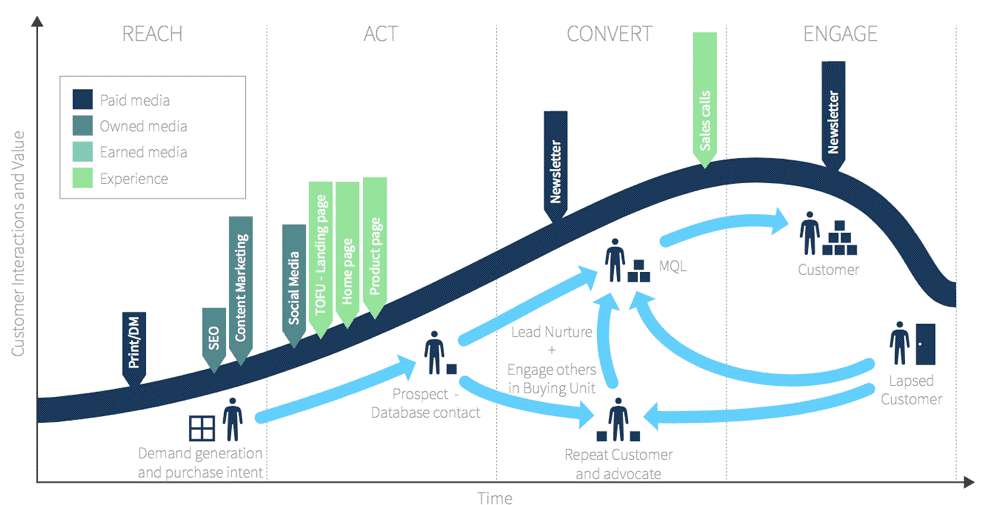
A way to plan to integrate online marketing into marketing activities is to consider communications from a customer’s point of view through the customer journey. This is often referred to as lifecycle marketing, I recommend you review your use of online AND offline media across the customer lifecycle.
An example of an audit is shown by this example of the use of marketing activities by a B2B company, which although strong at the top-of-funnel in terms of activities used, is less strong in the middle and bottom-of-funnel nurture and re-targeting activities. Many businesses are adopting marketing automation and account-based marketing technology to implement these touchpoints.
Trend 2. Conversational marketing
For me, this is the most exciting trend in marketing today, bringing together rapid consumer adoption of smart speakers and innovation in search query processing, conversational interfaces and messaging.
“Conversational marketing technologies enable interactions between companies and customers that mimic human dialogue and do so at scale. This category is near the Peak of Inflated Expectations phase”.
Personally, I think the hype about smart speakers to support the purchase journey is just that. While some products lend themselves to purchase, where a choice is to be made amongst complex products, they just won’t cut it until we have truly intelligent comparison bots. However, the research suggests I may be wrong. A study of 2,000 British adults commissioned by Artefact UK, an AI and data-driven agency, reveals that:
“Six out of ten smart speaker owners (60%) have used them to make a purchase in the past year. In fact, nearly a quarter (22%) said they have done so within the past week”.
I believe that building in more relevant to web, email, and mobile-based conversations can have a bigger impact by boosting the relevance and speaking in a more personal tone, this can be achieved through a combination of AI and real-person customer interactions.
Many platforms now provide analytics to allow you to adjust to the best communication messages, with content and timing.
Trend 3. Insights-driven marketing
At Friendlier Organics, we’re huge fans of using analytics and insight to drive business performance and optimize the results from digital marketing. It’s why we’re called what we are, as we love to support organic growth.
However many small businesses, either do not have the time to interrogate the data or lack the knowledge to get the most out of their stats.
Improving their data-driven marketing is an aim of many business owners.
Intensive users of customer analytics are 23 times more likely to clearly outperform their competitors in terms of new customer acquisition than non-intensive users, and nine times more likely to surpass them in customer loyalty.
Trend 4. Marketing technology
Today, Marketing Technology (Martech for short) presents a bewildering choice of software services for businesses looking to improve their management of digital media, experiences, and supporting data. If your business and your agencies adopt the right blend of Martech, it can help give you an edge against competitors, but if not, you may be missing out on the insights and automation processes they are using.
With Martech it is important to clearly identify the goals you wish it to achieve, there is a danger that you can become overwhelmed by choice and suffer paralysis by analysis. This is where a great marketing consultant can support your business as they are not linked to any particular service.
Trend 5. Consumer Privacy, Trust, and KYC
Repeated privacy faux-pas by Facebook, Google, and security breaches at other brands leading to the release of customer details have highlighted to consumers that their data isn’t as safe with online brands as they may have once thought. Privacy regulations have been enacted to improve data privacy with increased fines. What are you doing to build digital trust with your customers? Do they feel safe that the data you have stored is sufficiently protected?
British Airways, was issued with a proposed fine of £183m for a breach of customer data and a £99 million fine on hotel chain Marriott for failing to protect personal data contained in approximately 339 million guest records.
While these may be more the concerns of the CIO or CFO rather than the CMO, it shows the need for marketers to work with colleagues to mitigate the potential impact of security breaches and reassure customers.
At the same time, we have seen decreasing effectiveness of traditional identification methods such as cookies for tracking, which makes media ROI determination – supposedly one of the key benefits of digital channels – more difficult.
Emerging technologies can potentially help with both of these challenges.
New Identify Management or Know Your Customer solutions are being developed that can both improve security, reduce fraud and improve insight about customers across multiple devices.
With these consumer concerns and new legislation being updated all the time and the inaccuracy of tracking online with increasing restrictions built into browsers like Chrome and Safari, it seems like the days of the cookie (and particularly third-party cookies) and digital fingerprinting may be numbered. This means that businesses should be considering other alternatives if they aren’t already.
Trend 6. Digital transformation and Marketing Transformation
As I mentioned at the start of this blog, many companies run their digital marketing outside of their overall marketing strategy. Problems included a lack of focus on integrated strategy, testing, and a lack of understanding on how to utilize digital marketing effectively.
Most business owners have had bad experiences with digital marketing due to a lack of knowledge and understanding and have had to trust the third-party provider, only to have their fingers burned.
More and more small businesses are reaching out to marketing consultants to ensure that third-party providers are implementing their digital strategy correctly. As a business owner, do you have time to read the reports and correlate that all the insights and data are showing progress?
The aim of digital transformation is to develop a roadmap to improve digital capabilities and skills, while at the same time, integrating ‘always-on’ digital marketing activities with brand and product marketing in the business.
Despite some talk that we might be in a post-digital world by the end of 2022 and some traditional marketers suggesting that “it’s time to shut down digital marketing for good” the reality is that many specialist third-party provider roles are needed to run digital marketing activities. However, who is managing them?
A common practice that we can expect to continue in the future is a move to a hybrid approach to marketing and digital marketing, with marketing consultants providing the skills and knowledge to ensure effective marketing.
All the best for grasping the opportunities from digital marketing such as social media, SEO, website marketing, content marketing, digital advertising, etc in 2022 and beyond!
Email marketing has been around for a long time. However when managed correctly it is still one of the most powerful marketing tactics available to you, to achieve business success. Let’s dive in and consider the first impression a reader gets. From experience, a great subject line can transform open rates.
1. Learn from successful email subject line examples.
Whenever we’re scratching our heads wondering what to make our subject line, we often look to examples for inspiration. Seeing clever use of wordplay or emojis on one of our favorite newsletters can help us think of new ways to approach our subject line.
2. Keep it short and sweet.
Email subject lines will get cut off if they’re too long, particularly on mobile devices. And with up to 46% of email opens taking place on mobile, we recommend using subject lines with fewer than 40 characters to make sure the people scanning your emails read the entire message.
If you’re struggling to keep your subject lines short, think about which words matter less and where you can remove a frivolous detail. For example, if you’re sending an order confirmation, doesn’t “Your order is being processed” look better than “Order #9435893458358 is being processed”?
The same goes for your regular emails: Don’t waste your time including the word “update” or “newsletter” in the subject line. Some studies even suggest these words can decrease the message’s open rate since it tells readers the email is associated with a series, and therefore they can catch the next one.
3. Use a familiar sender name.
That name recognition we mentioned earlier doesn’t just apply to the famous — it applies to the familiar. When setting your sender name, be as human as you can. is both inviting and unintimidating to people when they open their inboxes.
If you’ve already met your recipients from a previous conversation, use your own name as the sender’s address — even if the email is technically coming from the company as a whole. The best impression you can make on your customers is that they’re working with you, the individual — not the entire business.
If the ‘from’ name doesn’t sound like it’s from someone you want to hear from, it doesn’t matter what the subject line is. Ultimately, people are busy, and they simply don’t bother with you if you don’t sound like someone who would make for an easy (or at least friendly) conversation.
4. Avoid the ‘no-reply’ sender name.
You would think common sense, but alas I get emails every day with no-reply. Your customers will receive large amounts of spam, therefore hesitate to open emails from unfamiliar senders. And, even fewer people like talking to a robot. Think about when you call a company and can’t get a hold of an actual person. It’s frustrating, right? This goes for email, as well.
Never use “.” I repeat: Never use this email address. Not only does it make it look less personable, but it also stops people from adding your email to their address book.
5. Use personalization tokens.
Remember the personalization we mentioned earlier? Using personalization tokens — like name or location — in the subject line adds a feeling of rapport, especially when it’s a name. Everyone loves the sound of their own name. Plus, it increases clickthrough rate: In fact, research has shown that emails that included the first name of the recipient in their subject line hadhigher click-through rates than emails that did not.
Another personalization tactic that works is to tailor subject lines to the recipient’s location — things like lists of their respective cities’ best outdoor bars and restaurants.
Just don’t go overboard with the personalization here. That can be a little creepy. But little personalized touches show that you know more about your recipients than just their email address. However, if you can’t (or don’t want to) use personalization tokens in the subject line, use “you” or “your” so it still sounds like you’re addressing them directly.
6. Segment your lists.
Failing to segment is a reason why email marketing can fail. While email blasts that go out to your entire list might be relevant and helpful to some people, it won’t be to others — and could cause confusion or frustration. Why is this restaurant sending me a list of the best local steakhouses when I’m a vegetarian? Why is this company sending me case studies when I just signed up for its email list yesterday?
Personalize the experience using information from the actions your customers have already taken — from which forms they’ve filled out, to which industries they’re in, to what their personal preferences are. In email marketing, you can personalize your recipients’ experience using a little thing called list segmentation.
7. Don’t make false promises.
Your email subject line is making a promise to your reader about what you will deliver in your message. Make sure that you make good on that commitment — and do not try to get your email opened by making false promises. This will irk your audience, and they’ll learn not to trust your subject lines, resulting in a lower open rate and a higher unsubscribe rate.
8. Do tell them what’s inside.
Speaking of making promises, if your visitor has downloaded an offer and you’re delivering it via email, it’s a great idea to use a subject line that says something like, “Your new ebook inside!” or, “Your guide awaits!” This works better than a simple “thank you” in the subject line because it makes it clear that something is waiting inside the email.
9. Time it right.
Sending an email at the right time with the right subject line can make a huge difference in open and click-through rate. A prime example? When food publication Eater sends at 6:45 P.M. on a Wednesday evening that said, “Where to Drink Beer Right Now” — just in time for happy hour. Nailed it.
Another favorite example is a classic email from Warby Parker with the subject line, “Uh-oh, your prescription is expiring.” It was sent two weeks before the recipient needed to renew his prescription. By sending an email at the right time, Warby Parker increased the chances of their email getting opened — and included a relevant call-to-action about getting a glasses upgrade, too.
10. Use concise language.
Keep in mind that people scan their inboxes very quickly — so the more clear and concise your subject line is, the better. It’s usually a lot better to be concise than it is to use complex and flowery language — unless you’re going for an elusive subject tone to entice your recipients.
When you’re going for a concise subject line, think about how your email will benefit your recipients. You’ll want to make that benefit very clear. For example, “Increase your open rates by 50% today” is more appealing than “How to increase open rates.”
11. Start with action-oriented verbs.
Subject lines are similar to calls-to-action, in that you want the language to inspire people to click. Subject lines that begin with action verbs tend to be a lot more enticing, and your emails could be drastically more clickable by adding a vibrant verb at the beginning.
Actionable subject lines will inspire people to click on your email by instilling urgency and excitement. For example, in an email inviting people to a hockey legend dinner, the email subject line might read, “Dine with Bruins legend Bobby Orr,” rather than a more generic (and less actionable) “Local Boston Sports Legend Meal.” The former email uses “Dine” to help the reader envision themselves at a dinner table.
12. Make people feel special.
The psychology of exclusivity is a powerful thing. When people feel like they’re on the inside, it gives them a sense of belonging which builds loyalty and compels them to convert on your emails.
The right phrasing can make your recipients feel special — and the effect can be magical. A few ideas for phrasing include:
“For our beloved customers only”
“An exclusive offer for you”
“My gift to you”
“You’re invited!”
“Private invite”
13. Create a sense of importance.
There’s a phrase that, for many of us, is reminiscent of classic infomercials: “Act now!”
And while we wouldn’t encourage using that exact language in your content, we do agree that communicating urgency and scarcity in an email subject line can help compel readers to click (or act) — when phrased creatively and strategically.
But because you don’t want to be known as “the brand that cried wolf,” use these subject lines sparingly, and try to limit them to when the occasion genuinely calls for immediate action.
14. Use numbers.
A lot of businesses send emails with vague statements in their subject lines — which is why using data and numbers is a great way to get your emails noticed, demonstrate a clear and straightforward message about your offer, and set the right expectations.
Just like with blog titles, using numbers in your subject line is an effective email marketing best practice. You might use numbers to refer to the title of your listicle, the page length of an offer, a specific discount, or the numerical benefit of a particular resource you’re providing — like “Join more than 750 others at this event!”
15. Pose a compelling question.
Asking a question in your subject line can also draw readers in — especially if you’re asking a question you know is relevant to your recipients’ buyer persona. This is just one way to pique that curiosity we mentioned earlier. For example, you might try the following: “Are you making these SEO mistakes?” or “Do you know what your website is doing wrong?”
Zillow once sent an email with the subject line, “What Can You Afford?” that linked to a website showing apartments for rent. A subject line like this is both encouraging and a touch competitive: While it gives hope that there are apartments out there that’ll fit within your budget, it also pits your cash against what the market offers.
16. Don’t be afraid to get punny.
Most people love a good pun. It’s a great way to delight your recipients and spice up your emails. Some of the best punny email subject lines come from JetBlue, with subject lines like “Land wander-ful low fares now!”
Quirky — a community-led invention platform — worded one of its email subject lines like this: “Abra-cord-abra! Yeah, we said it.” That second part is conversational and self-referential — and exactly what most people would say after making a really cheesy joke in real life.
If you’re the least bit punny, think about small ways you can slip them into your emails when it’s appropriate. Just don’t overdo it. And remember the rule: When in doubt, ask a coworker.
17. DON’T USE ALL CAPS or overuse exclamation points!!!
A subject line that says, “OPEN NOW AND RECEIVE A FREE TRIAL” or, “50% off coupon today only!!!!!!!!” isn’t going to get your email opened. If anything, it’ll probably get your email ignored.
18. Don’t include a question and exclamation in the same subject line.
Here’s a subject line that can automatically wind up in a recipient’s spam folder: “Want a solution fast? Act now!”
The fast solution isn’t the problem in the example above. It’s also not “act now” — although those are known email marketing spam words. It’s both phrases together. This is a classic email saboteur, and it comes in many forms. All you need is to ask and yell at the same time.
19. Use engaging preview text.
While preview text isn’t technically part of your subject line, it does appear right near the subject line — and it certainly deserves your attention.
Preview text provides recipients with a peek at the content inside your email, which email clients like the iPhone Mail app, Gmail, and Outlook will display alongside the subject line. (The exact amount of text shown depends on the email client and user settings.)
20. A/B test your subject lines.
Although these tips and best practices are a great place to start, what works best for some companies may not work as well for others. It’s all about figuring out what works best for your specific audience. That’s where A/B testing comes in. While it can be tempting to use your intuition to predict what subject line language will make people click on your emails, you should always A/B test your highest-stakes subject lines, and tweak the wording according to your results. What works best for your audience: Long or short subject lines? Including numbers or not including numbers? Questions or statements?
To summarise, ask yourself the question, why would my customer open this email, what benefit is it to them? Answering that question and applying the above will see an increase in your open rates.
As business and marketing consultants we can advise and guide you to improve your email marketing.
Why do we need a good subject line? Each email you send gets one chance of making a great impression. The subject line and snippet is your email’s chance to make a great impression. Each email is a fresh impression, regardless of how many you have sent previously.
Regardless of your goals, these are the essential elements that your subject line should possess:
1. Urgency
Creating a sense of urgency is an efficient way to get people to take action. You can create a similar effect in your subject lines strategically.
By communicating a known start and end date to a special sale or promotion, viewers scrolling through their inbox will click to see what they can get in that window of time. This is also a good practice when done in a small series of emails counting down the window of opportunity — as long as you’re not flooding their inbox and coming off spammy.
2. Curiosity
Sometimes, subject lines work because of their ability to send the message, “You will benefit from opening this email.” But other times, it’s good to maintain some sense of mystery — especially if it pique’s the recipient’s natural curiosity and interest. Because they require opening the email to get more information, they can result in, well, a higher open rate. But make sure the subject line, while enigmatic, still aligns with your brand. Too obscure, and it could end up being seen as spam.
3. Offers
Here’s where that benefit of opening a given email comes in. At the end of the day, people love new things and experiences — especially when they’re free, or at least discounted. Open with that by including it in your subject line. Personally, I’m much more inclined to open my daily newsletters when there’s an offer or allusion for “free stuff” directly mentioned in my inbox.
4. Personalization
No two email subscribers are the same — and, sometimes, that means the emails you send to them shouldn’t be, either. At this point, marketers have never had more ways to learn about their subscribers’ preferences, jobs, or general (dis)likes. So when you send them content, on occasion, make it catered toward the individual.
5. Relevance and Timeliness
When we subscribe to an email list, it’s usually because we want to be kept informed, or at least learn more about a given topic (more on that later). Similar to piquing your audience’s curiosity, crafting email subject lines that incorporate trending topics or timely headlines can help you establish your brand as an authority within your industry — and can compel people to click to read.
6. Name Recognition
Let’s face it: We all have famous people who, at some point, we presently or previously have admired. And when you understand your audience’s preferences and interests, you can pique their interest by including the names of these admired, recognizable individuals by including them in your content — and mentioning them in your email subject lines. But take heed: This tactic really only works when it aligns with your brand, product, or service. So keep it relevant, rather than just throwing out a name for the sake of recognition.
7. Cool Stories
At the risk of sounding like a broken record, here’s another place where curiosity comes into play. By front-loading your email subject line with a compelling allusion to a story — but can only be read if opened or clicked — your audience is likely to become intrigued, and want to learn more. Again, make sure the story is relevant to your brand. Otherwise, it might just confuse your readers and prevent them from opening the email.
As with all forms of marketing communication, email marketing works best, when it delivers consistent correct communication. This is achieved by measuring and managing the process.
Need a hand achieving your marketing goals, reach out for a free consultation.
As an expert in Email Marketing Paul has kindly written the following article to share his understanding of how email marketing works within the current climate of the pandemic. Personally, I am a huge advocate of email marketing to grow a business and as a tool to improve customer relationships.
Back in March 2020, we were scheduling our email news deliveries for 10 a.m., we were sending targeted campaigns using segments, had multiple automated email journeys on auto-pilot, and thought we had our email content calendar locked down for the next few months. Our lists were growing and everything was on track.
Then Covid-19 came along. And everything changed. Everything.
According to Statista, in 2019, the number of global email users amounted to 3.9 billion and is set to grow to 4.48 billion users in 2024. Add in mobile email users and it still proves to be the best way to communicate with each other and with customers.
One year on and has this changed and, more importantly, has our behaviour changed? Do we go about our everyday lives and behave the same way as we did pre-Covid? No, we now have to deal with physical- and social-distancing, working from home, mask-wearing, and looking for new ways to keep earning a crust.
How does email marketing now fit into this new world?
Looking Back… Briefly
A recent study of Covid-19 email benchmarks indicates that the amount of email hasn’t significantly increased this past year but open rates have while click rates remain the same.
“[People] want to know how the brands they follow are changing their business plans or responding to the crisis, and the increase in opens shows that email is still where consumers go to hear from brands.”
Stay-at-home orders around the world forced many businesses without a digital storefront to quickly create one. And people who’ve never shopped online before did so for the first time.
So email remained the best way for companies to communicate with their customers. As a result, email revenue is up pretty significantly, especially in ecommerce.
So what can you do to make the same tool work better? Here are a number of techniques to consider.
Change the Delivery Time
Knowing that more people are now working from home, consider sending at 9 a.m. rather than 7 a.m. so your email arrives in their inboxes when they are more likely to open and be ready to engage.
Be Respectful of Inboxes
Sending more email will likely not get the reaction you are looking for. More likely is an unsubscribe or worse, your email is flagged as spam and your online reputation takes a nosedive. Look at your content with the highest engagement and focus on that.
Know your Audience
Past email benchmarks reports consistently show that there’s no clear winner for which day is the best to send. Brands should test and see what their audience acclimates to then continue with that pattern. In March 2020, we saw the highest engagement metrics on days other than Tuesday (highest volume for that month) and weekends (lowest volume).
A great tool to use is the A/B subject line tester. Try out the best subject lines then send using the subject line more likely to trigger an open rate.
You may also like to use time zone optimization to have your email delivered at the same time across every time zone.
Send time optimization will dive a little deeper and send an email when the subscriber is most likely to open based on their past behaviour.
Show Empathy, Don’t Keep Selling
A year is a long time to be in some sort of restriction and many people have suffered. You don’t know what is going on in other people’s lives so show some empathy for the global situation.
Tell a story about how you are helping people in your local community and working with local charities, or give your resources and contractors some exposure.
Lastly, mention that you have something to sell. Shift that focus down until you feel people are ready then shift it back up above the fold.
Review your Subscription Options
Soften the signup language, be transparent about what it will be about and how often you will send. Be honest then stick to a schedule. Protect your online reputation.
An inconsistent schedule is one way to “go dark” and have your customers unsubscribe when you come back to life. Stay in front of customers, be consistent, be kind, be respectful.
In the long run, people will remember that you supported them and gave them what they signed up for in a gentle and respectful way.
A huge thanks to Paul for sharing his knowledge and understanding to make email marketing an integrated tool within your business growth strategies.
The world of search engine optimization (SEO) is never dull. Just when you think you’ve got it areas like website SEO and Blogs mastered, Google will usually come up with something new to keep you on your toes. Google’s goal is to provide the absolute best user experience, and of course, provide data to advertisers so they can make profits. With both these objectives in mind, it is fair to say that user expectations are continually changing so is the search engine’s approach to keeping them happy. How many times have you carried out a Google search for a simple answer and wished the answer was there without having to click through to a website?
Good News, for a couple of years Google has been listening, not only have they introduced Google My Business but also improving what is called featured snippets or also known as position zero. As with most things, there are pros and cons to any goal. Consider this, you provide the answer to the search but get no click through to your website, so no SEO benefit or potential sales? However, are you being remembered in the mind of the customer for the future? The click-throughs are easy to measure, ascertaining if a customer has come to you, days, weeks, or months after being helped by your featured snippet is not so easy to measure.
Before embarking on the SEO challenge of achieving position zero, you need to look at your business growth strategies and the benefits of achieving position zero. Position zero can potentially give you massive brand awareness, assuming of course the searchers sees that you provided the information and not just reads the answer.
Understanding What Position Zero Means in SEO
You’re likely familiar with the concept that you want to rank as high as possible on page one Google’s search engine results. The higher, the better, but can you actually do better than the number one position? Yes, let us introduce you to position zero.
The goal of position zero is to answer a search engine user’s query right there on the first page. From Google’s perspective, this provides a high level of satisfaction to the user and keeps them inside Google. For many businesses, position zero is the ultimate way of gaining visibility and traction.
Featured snippets are displayed right above the number one ranked spot, which is why it’s called position zero. Keep in mind that the webpage that wins this coveted spot might not be the highest ranked for the query, it’s just the one that Google decided did the best job of providing an immediate answer to a user’s question.
For example, if a user enters the query “What are the best colleges on Vancouver Island?” a position zero listing might be a paragraph that describes a college that recently earned the distinction of being number one, or the featured snippet could be a bullet list of the top 10 colleges.
Getting to Zero
There’s an energized focus in search engine marketing to get to position zero, but achieving it requires a different set of strategies than merely ranking high in search results and they all revolve around content.
The first step is to realize that position zero features an answer to a question. This means that when you’re creating content, you want to focus on providing answers in a way that they can easily be pulled out and displayed. For example, short paragraph answers, lists and bullet points dominate position zero.
Secondly, we know this doesn’t come as a surprise, but keyword research is a must. The way users are asking questions to search engines is different than it has been in the past. Local SEO and the rise of the use of voice devices means that keywords need to reflect a more natural language pattern rather than a short, choppy string of words.
Consult SEO Experts
It is not something that the average business owner can normally achieve without support. As with any SEO marketing, by using experts in this field you will achieve where you want to go much faster.