

In this blog, we will explore six key marketing trends that many businesses are currently applying to ensure sustainable growth.
It is very clear that digital marketing has made a huge impact over the last decade, and more. You only have to look at the advertising spend on Google and Facebook/Instagram. It is important at this point to mention that implementing an integrated marketing strategy will show the best results and support your digital marketing efforts.
Trend 1. Lifecycle marketing
The “funnel” has been around for decades, it is not something new, despite the claims of many self-proclaimed digital marketing gurus. Digital marketing provides sufficient data to fine-tune this tunnel, assuming you can interpret the huge amount of data and make informed decisions.
Although, recently, many marketing gurus are now claiming that the ‘funnel is dead’ since consumer follows non-linear journeys, regardless of the product or service you’re involved with marketing.
It will always be the case that to successfully grow a business, your primary focus is growing awareness, closely followed by increasing a customer’s desire for your product or services, which leads to action on their part. This journey may take seconds or weeks depending on the complexity of the purchase.
The role of digital marketing should be to create a unified customer experience, which can be utilized to maximize your existing customers in growing your business.
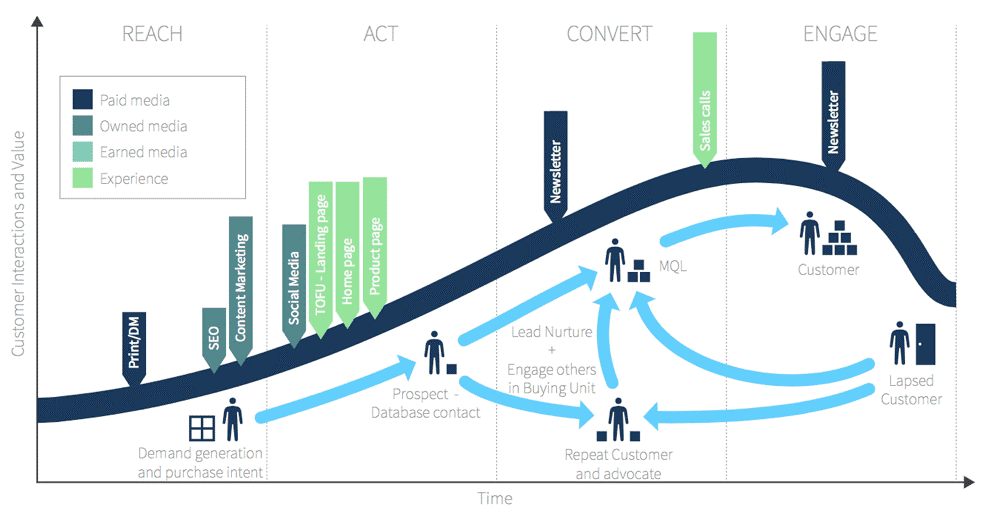
A way to plan to integrate online marketing into marketing activities is to consider communications from a customer’s point of view through the customer journey. This is often referred to as lifecycle marketing, I recommend you review your use of online AND offline media across the customer lifecycle.
An example of an audit is shown by this example of the use of marketing activities by a B2B company, which although strong at the top-of-funnel in terms of activities used, is less strong in the middle and bottom-of-funnel nurture and re-targeting activities. Many businesses are adopting marketing automation and account-based marketing technology to implement these touchpoints.
Trend 2. Conversational marketing
For me, this is the most exciting trend in marketing today, bringing together rapid consumer adoption of smart speakers and innovation in search query processing, conversational interfaces and messaging.
“Conversational marketing technologies enable interactions between companies and customers that mimic human dialogue and do so at scale. This category is near the Peak of Inflated Expectations phase”.
Personally, I think the hype about smart speakers to support the purchase journey is just that. While some products lend themselves to purchase, where a choice is to be made amongst complex products, they just won’t cut it until we have truly intelligent comparison bots. However, the research suggests I may be wrong. A study of 2,000 British adults commissioned by Artefact UK, an AI and data-driven agency, reveals that:
“Six out of ten smart speaker owners (60%) have used them to make a purchase in the past year. In fact, nearly a quarter (22%) said they have done so within the past week”.
I believe that building in more relevant to web, email, and mobile-based conversations can have a bigger impact by boosting the relevance and speaking in a more personal tone, this can be achieved through a combination of AI and real-person customer interactions.
Many platforms now provide analytics to allow you to adjust to the best communication messages, with content and timing.
Trend 3. Insights-driven marketing
At Friendlier Organics, we’re huge fans of using analytics and insight to drive business performance and optimize the results from digital marketing. It’s why we’re called what we are, as we love to support organic growth.
However many small businesses, either do not have the time to interrogate the data or lack the knowledge to get the most out of their stats.
Improving their data-driven marketing is an aim of many business owners.
Intensive users of customer analytics are 23 times more likely to clearly outperform their competitors in terms of new customer acquisition than non-intensive users, and nine times more likely to surpass them in customer loyalty.
Trend 4. Marketing technology
Today, Marketing Technology (Martech for short) presents a bewildering choice of software services for businesses looking to improve their management of digital media, experiences, and supporting data. If your business and your agencies adopt the right blend of Martech, it can help give you an edge against competitors, but if not, you may be missing out on the insights and automation processes they are using.
With Martech it is important to clearly identify the goals you wish it to achieve, there is a danger that you can become overwhelmed by choice and suffer paralysis by analysis. This is where a great marketing consultant can support your business as they are not linked to any particular service.

Trend 5. Consumer Privacy, Trust, and KYC
Repeated privacy faux-pas by Facebook, Google, and security breaches at other brands leading to the release of customer details have highlighted to consumers that their data isn’t as safe with online brands as they may have once thought. Privacy regulations have been enacted to improve data privacy with increased fines. What are you doing to build digital trust with your customers? Do they feel safe that the data you have stored is sufficiently protected?
British Airways, was issued with a proposed fine of £183m for a breach of customer data and a £99 million fine on hotel chain Marriott for failing to protect personal data contained in approximately 339 million guest records.
While these may be more the concerns of the CIO or CFO rather than the CMO, it shows the need for marketers to work with colleagues to mitigate the potential impact of security breaches and reassure customers.
At the same time, we have seen decreasing effectiveness of traditional identification methods such as cookies for tracking, which makes media ROI determination – supposedly one of the key benefits of digital channels – more difficult.
Emerging technologies can potentially help with both of these challenges.
New Identify Management or Know Your Customer solutions are being developed that can both improve security, reduce fraud and improve insight about customers across multiple devices.

With these consumer concerns and new legislation being updated all the time and the inaccuracy of tracking online with increasing restrictions built into browsers like Chrome and Safari, it seems like the days of the cookie (and particularly third-party cookies) and digital fingerprinting may be numbered. This means that businesses should be considering other alternatives if they aren’t already.
Trend 6. Digital transformation and Marketing Transformation
As I mentioned at the start of this blog, many companies run their digital marketing outside of their overall marketing strategy. Problems included a lack of focus on integrated strategy, testing, and a lack of understanding on how to utilize digital marketing effectively.
Most business owners have had bad experiences with digital marketing due to a lack of knowledge and understanding and have had to trust the third-party provider, only to have their fingers burned.
More and more small businesses are reaching out to marketing consultants to ensure that third-party providers are implementing their digital strategy correctly. As a business owner, do you have time to read the reports and correlate that all the insights and data are showing progress?
The aim of digital transformation is to develop a roadmap to improve digital capabilities and skills, while at the same time, integrating ‘always-on’ digital marketing activities with brand and product marketing in the business.
Despite some talk that we might be in a post-digital world by the end of 2022 and some traditional marketers suggesting that “it’s time to shut down digital marketing for good” the reality is that many specialist third-party provider roles are needed to run digital marketing activities. However, who is managing them?
A common practice that we can expect to continue in the future is a move to a hybrid approach to marketing and digital marketing, with marketing consultants providing the skills and knowledge to ensure effective marketing.
Leave a Reply