+1 250-855-2260
Contact us

Category: Marketing

  • How to Thank Your Clients This Christmas

    How to Thank Your Clients This Christmas

    As the Christmas and festive holidays, fast approach and the end of another calendar year come into view, if you have not already done so, it’s time to start thinking about how to thank your client this holiday season.

    The most popular way to do this is by sending clients a heartfelt Christmas message or a suitable client gift.

    It is important to put thought and consideration into any potential messages and gifts. Consider the public relations consequences of your actions. However, no action is not an option.

    Why is thanking clients at Christmas so important?

    • It creates a positive association with your brand and business values, making customers less likely to switch to a competitor, even when you hit their price point for potentially switching – Forbes research found that 43% of companies believed gift giving brought a substantial benefit to increasing customer loyalty.
       
    • It helps to build a relationship between you and your clients – one survey found that 63% of companies attributed better customer relationships to gift-giving.
       
    • It leaves a memorable and lasting impression – 66% of gift receivers can recall a brand name on a received promotional item after 1 year. It may offset the odd time we are all human and make a mistake.
       
    • It promotes goodwill and very often leads to increased client recommendations. When you consider the power of reviews and recommendations in modern marketing, this element alone is worth the time and effort.

    How do you say thank you to your clients this Christmas?

    Here are our top suggestions:

    1. Send Christmas cards with thank you messages to clients

    In the modern world of digital, standing out from the crowds and ensuring your message is received and read, it might be time to go old school. Sending a thank you message to customers at Christmas via post is a personal and meaningful way to show your appreciation, more so than via email.

    By sending a bespoke Christmas thank you card with your business’ design you’ll be able to increase brand awareness whilst also making your client feel valued.

    Make sure to include a personal message thanking them for their business.

    What should you say in your client’s Christmas card messages?

    • Be clear about why you’re thanking them – this could be for their continued loyal, service, the pleasure of working with them over the last 12 months, or welcoming them on board
       
    • Make it personal yet professional – don’t use the message to promote your service, instead use it to promote a positive working relationship. There will be plenty of time in the new year to remind your customers of your services old and new.
       
    • Encourage all of your colleagues who work with the client to sign the card. If this is not possible you could scan signatures and have them printed into the cards. A better alternative to doing nothing.
       
    • Need some inspiration for your client’s Christmas message? Here are some ideas to get you started:
      • “Happy holidays to all at [client name]. Thank you for your continued support.”
         
      • “Sending Christmas greetings from our entire staff. Thank you for your ongoing support. We’re looking forward to serving you in earnest over the next year.”
         
      • “Best wishes for the season of joy. Thank you for trusting us with your [relevant service] needs.”
         
      • “It’s customers like you that make our job so enjoyable. Merry Christmas to all and best wishes for the year ahead.”

    When do you send the card? If it has a Christmas message then give yourself plenty of time to ensure they receive your thanks. An alternative is to wait until the hectic festive period is over and send them a thank you message between Christmas & New Year (ensure you use the correct tense), this might increase the engagement and attention your customer gives to your message. Consider how many messages they are being bombarded with leading up to Christmas.

    2. Send them client gifts for Christmas

    Sending clients Christmas gifts is a great way to thank your customers and boost your working relationship.

    In fact, 94% of top business executives believe that client gifting can impact a business relationship.

    When sending Christmas thank-you presents to clients, there are a few things to consider:

    • Your budget – how much are you willing to spend per client? Remember, it isn’t necessarily all about how much you spend on a client, but rather the sentiment of the gift
       
    • Does your client’s spending threshold with you qualify them for a gift? Consider different size gifts for different client spends. However, be aware that clients may talk to each other.
       
    • Will your gift align with their individual or company values? A client following a vegan diet may not appreciate a cheese selection
       
    • How will you make it personal? It’s popular to include a gift card or Christmas client message alongside a gift
       

    Not sure what to send? Here are some ideas:

    • A bottle of wine or bubbly
       
    • Personalized stationery with your company’s details – for example, a custom notebook
       
    • If you sell a physical product, you could send one or a selection of these as a gift for their team to enjoy
       
    • A Christmas food basket
       

    Check with your bookkeeper and account to identify how to write off Christmas Gifts.

    3. Take them out for a festive lunch or invite them to an event

    For clients with a higher annual spend or those that are important to the business, you may consider inviting them to a festive lunch or an event.

    This is a brilliant opportunity to thank them for their business whilst engaging them in conversation, asking them about their experience with your business over the last 12 months, and solidifying your partnership for the following year.

    This gives them a further positive association with you and the company itself.

    You could also look at holding a festive event or dinner for prestigious clients, giving an opportunity for everyone to come together for an evening of fun to celebrate the year gone.

     4. Make a donation in their name

    Embrace the true spirit of Christmas by giving to a cause that you believe in, or one that is important to your client.

    By doing so in their name and selecting a charity aligned with their vision and values, you’re showing that you appreciate and understand their business and see them as valued client.

    This will likely build rapport between you and your client and may encourage further business in the future.

    5. Post about them on social media

    A positive social media presence can do wonders for the image of your company which can encourage prospective clients and even jobseekers to consider making contact with you.

    By posting about them, you’re making an effort to publicly show your appreciation to them, which can benefit your working relationship and in turn, by giving them a spotlight, your post could be sending more traffic to their website and giving them more customers. This shows that you value their success.

    Not sure what to post? This could be a simple thank you post, a photo of a meeting, or a resharing of one of their posts. But don’t forget to tag them!

    Finally, whilst you’re looking for client Christmas gift ideas, it may be time to start planning your corporate Christmas gifts for employees too.

    After all, 80% of companies have reported improved relationships with their employees or clients following gift-giving.


  • Do you know who your customers are?

    Do you know who your customers are?

    Firstly let me say this is not a criticism of clients. You know what you know until someone points out what you don’t know but need to know.

    Hence why they come to Friendlier Organics for marketing and business support.

    When it comes to business success and effective marketing, almost nothing is more important than knowing your target audience. How can you expect to have effective marketing communications without the knowledge of your customers and wider audience?

    However, what if I told you over half the businesses we deal with when we carry out a marketing audit, have missing critical information on their consumers? Resulting in a customer disconnect and often miscommunications.

    Reflecting back on our clientele for the last two years, we found that only 35% initially knew the basic demographic information of their target audience, like their name, gender, age and location. When asked to create a series of customer avatars 70% could not provide the information.

    Some additional analysis revealed the following:

    • Less than half of business owners know their audience’s interests and hobbies, shopping habits, the products they are interested in buying, their purchase history, and where they consume content. Despite access to technology that could easily provide the data.
    • A third know the online communities their target audience is a part of and even less know the challenges they are facing. This date has a huge impact on buyer behavior patterns.
    • One in six of our clients knew the social causes their target audience cares about – a huge missed opportunity when it comes to expressing your brand’s values, especially when this is a great Public Relations Marketing opportunity.  

    So why are business owners having such a hard time getting these data points?

    Let’s discuss the biggest challenges business owners face in getting the data and turning that into the information they need and identify some solutions to the disconnection many are seeing with their audience.

    The Biggest Challenges Marketers Face in Understanding Their Target Audience

    As a marketing consultant, I cannot express the importance of marketing management data. Having high-quality data on your target audience is important to succeeding in their business. Quality marketing management data allows for informed decisions about marketing. So why is it such a challenge for marketers to get the data they need?

    The biggest challenges in understanding your target boil down to two main issues:

    1. Data Privacy Measures

    Data privacy legislation and technology providers such as Apple are reducing access to the consumer data they need. In addition to the increase in public breaches in security, consumers are less trusting in sharing their personal data.

    This results in business owners missing out on critical data on their target audience, from their online shopping and media such as social media, email, and search engine search consumption habits to their basic demographic information.

    2. Evolving Audience Targets

    Consumers’ lives have changed drastically over the past few years, and do not stay constant, with the addition of a potential economic downturn or recession, their habits, attitudes, and preferences are likely to continue shifting quickly and buyer behavior patterns will be harder to identify and predict.

    The two challenges above are difficult to overcome because they’re actively developing as data privacy regulations tighten and unprecedented events that change consumer behavior continue.

    So, what can you do now?

    How Can You Improve Their Data Strategy?

    1. Gather First-Party Data

    A great solution to increased data privacy regulations like Google’s planned phase-out of third-party cookies is gathering your own first-party data.

    First-party data can be collected from many sources – your website, surveys, email, SMS, your CRM, and more.

    Since first-party data comes directly from your customers, it offers high-quality insights about your audience and allows you to create a personalized experience for them.

    2. Use a Single Source of Truth for Marketing Data

    A little research showed that only 21% of small business owners say their marketing data is fully integrated with their systems and tools, and as we saw earlier, data not integrating well is a top challenge for small business owners, trying to understand their target audience.

    Disconnected marketing data is problematic because you don’t have the full context needed to make data-driven decisions. On the other hand, a single source of truth offers a holistic view of your target audience by connecting all the data points you have.

    A single source of truth also improves efficiency by making marketing data more easily accessible for marketers and their collaborators.

    3. Keep Your Data Fresh

    We talked about how consumers’ lives are changing rapidly and marketers need up-to-date data in order to keep up.

    The interests, habits, and attitudes of your target audience probably changed several times over the course of the pandemic. And with a recession looming, your audience will likely change again – so whatever data tracking method you use, make sure your data is regularly updated to keep a pulse on your customers in real time.

    Another reason you need up-to-date information on your target audience is so you can pivot your marketing strategy and message in response to the changes your customers are experiencing.

    Needless to say, you need a plan for when things go off course. When the next unprecedented event or unexpected challenge arrives, will you have the data you need to adapt?

    Unsure if your plans are acceptable for any potential change, reach out for a consultation.

    In an ideal world, you would have all the data points you could ever want, but that isn’t always realistic. So let’s end by taking a look at which data points are most helpful.

    The Most Helpful Types of Audience Target Data

    As a Marketing Consultant, the interests or hobbies of their target audience is the most helpful data point, closely followed by consumers’ shopping habits, where they consume content/media, and the products they are interested in buying.

    Basic demographic information, purchase history, and the online communities their target audience is part of are also valuable data points.

    A Crisis of Connection

    If you’re realizing you might be missing critical information on your target audience, don’t worry, you aren’t alone. We would not be so busy if you were alone with these struggles.

    Many businesses are currently experiencing a Crisis of Disconnection, and it goes far beyond poor customer data.

    If all of this has caused more concerns than solutions please reach out for an initial free consultation.

  • What is Marketing?

    What is Marketing?

    If you asked 50 business owners in Nanaimo you would get 50 different answers. If you combine the Chartered Institute of Marketing and the American Marketing Associations definition it would be could be defined as follows:

    “Marketing is the activity, set of instructions, and processes for creating, communicating, delivering, and exchanging offerings that have value for customers, clients, and stakeholders at large.”

    However, what does this actually mean to the small business in Nanaimo? Breaking it down, activity is not only the promotional activity such as Logo design,  digital marketing, social media marketing, etc. but any activity your business undertakes that sends a message, this will include customer care, how you deliver (or not) your offering, any follow-up post offering. It also involves the intrinsic communications that you send to customers, often referred to as your brand values and brand reputation, the real why you do what you do, that is not financially related.  

    With this in mind, marketing also has an internal element, your people and processes will send a more powerful message than any promotional activities you might undertake. Consider a member of staff having poor interactions with customers, versus a google AdWords campaign. Which will impact greater on the sustainable success of your business?

    Here at Friendlier Organics we are passionate about all aspects of marketing and believe it is a principle that should be at the core culture of all businesses, rather than just a promotional function.

    We understand that not everyone can be the ultimate best or the cheapest, however, when considering the 4 P’s of your marketing mix, you can be the best within your brand/business positioning. For instance, you can be the best customer care within your price bracket.

    Marketing in its modern form has been around since In the 1960s with Philip Kotler, and E Jerome McCarthy developing marketing theories over 60 years ago. The mediums may have changed from Print, Radio, and TV to social media, Google My Business, and websites but the theories hold strong.

    As a starting point, you can review your business’s 4 Ps.

    Product

    Let’s say you come up with an idea for a product you want your business to sell. What’s next? You probably won’t be successful if you just start selling it.

    Instead, you need your marketing team, which may be you, to do market research and answer some critical questions: Who’s your target audience? Is there a sufficient market fit for this product? What messaging will increase product sales, and on which platforms? How should your product developers modify the product to increase the likelihood of success? What do focus groups, if you do not have the budget for a focus group, you could ask friends and family who fit with your customer demographic, think of the product, and what questions or hesitations do they have?

    Marketers and business owners use the answers to these questions to help businesses understand the demand for the product and increase product quality by mentioning concerns stemming from focus group or survey participants.

    Price

    Your marketing team will check out competitors’ product prices, or use focus groups and surveys, to estimate how much your ideal customer is willing to pay. Price it too high, and you’ll lose out on a solid customer base. Price it too low, and you might lose more money than you gain. Fortunately, marketers can use industry research and consumer analysis to gauge a good price range.

    Place

    It’s critical that your marketing department, again this might be you, uses their understanding and analysis of your business’s consumers to offer suggestions for how and where to sell your product. Perhaps they believe an eCommerce site works better than a retail location, or vice versa. Or, maybe they can offer insights into which locations would be most viable to sell your product, either nationally or internationally.

    Promotion

    This P is what most consider to be marketing, it is likely the one you expected from the get-go: promotion entails any online or print advertisement, event, or discount your marketing team creates to increase awareness and interest in your product, and, ultimately, lead to more sales. During this stage, you’ll likely see methods like public relations campaigns, advertisements, or social media promotions.

    Hopefully, our definition and the four Ps help you understand marketing’s purpose and how to define it. Marketing intersects with all areas of a business, so it’s important you understand how to use marketing to increase your business’s efficiency and success.

    Unsure if all your 4P’s of marketing are sending out the same messages to your clients and stakeholders then please book an initial marketing consultation.

    free marketing consultation
  • 10 Signs It’s Time to Stop Your Marketing Campaign

    10 Signs It’s Time to Stop Your Marketing Campaign

    In the business and marketing world, pulling the plug on a campaign can be extremely difficult, especially when you and others have put time, money, and energy into a marketing campaign. This is why many hire marketing consultants to provide an impartial view of your campaigns without emotional attachments.

    If you do not have a marketing consultant, here are 10 signs it might be time to pull the plug on your marketing campaign.

    Why Stop a Marketing Campaign?

    You should stop a marketing campaign if you’ve given it enough time and there’s still no sign of success. A business might also stop a marketing campaign if the metrics don’t add up or if the campaign isn’t resulting in quantitative business growth.

    10 Signs It’s Time to Stop Your Marketing Campaign

    No two campaigns are the same, but these ten signs indicate that it’s time to stop a marketing campaign.

    1. If you’re not getting enough value

    How do you know whether a marketing campaign is giving you enough value? Well, ask yourself:

    • Are you going to break even on the money you’ve spent?
    • Does the cost far exceed the value you’ll get?

    If the numbers don’t add up, it might be time to stop the campaign.

    2. If you’ve given enough time

    Marketing campaigns require patience. Sometimes, you might not even see the results from certain campaigns in months.

    However, if your marketing campaign takes way longer to generate positive results when compared to other campaigns of its kind, then it’s time to pull the plug. Always measure like with like.

    3. Your optimizations don’t change anything

    Suppose, in a bid to save a campaign, you begin to optimize different elements but still don’t notice any improvements; then, you should end the campaign.

    You’d be better off spending your time and resources on other campaigns or revenue-generating activities.

    4. It’s cheaper to stop now

    If you’ll save more time and money by pulling the plug now rather than later, then that’s a sign the campaign needs to end right away!

    5. When you’ve tried your best

    If you and the team have tried all methods and tricks in the book to no avail, then it might be time to resign and move on with some pride left.

    6. If you’re getting negative results

    You know it’s time to pull the plug on your campaign if your weekly reports mostly contain red downward arrows instead of the green upward arrows

    7. If other campaigns are working

    You’re likely running more than one campaign at the same time. If you notice that all of your other campaigns generate the results you want, it’d be smart to drop the underperforming campaigns.

    8. When your campaign sends the wrong message

    Even the most well-meaning marketing campaign can get a ton of backlash from the public. Whenever a campaign is met with such a negative response, it’s best to unplug the campaign and go back to the drawing board to whip up a new one.

    9. You’re getting the wrong clients

    You should consider stopping your campaign if you’re engaging the wrong audience and attracting not-so-ideal clients.

    For instance, if your goal is to get giant corporations, but you’re inundated with SMEs, then you should have a hard look at your campaign.

    10. You’re missing timelines

    When creating a campaign, you should tie results to a specific timeline. If you find that you and your team are consistently having difficulties sticking to a campaign’s timeline, then you might need to pull the plug.

    What to Expect When Your Marketing Campaign Ends

    Here are some things a business should expect when it stops an effective marketing campaign:

    • A drop in the number of leads and acquisitions
    • Lower impressions on social media
    • A decrease in search traffic
    • Inability to maintain growth

    Therefore, if you have to stop a marketing campaign, you should have a backup plan in place. Have another campaign ready to go as soon as you stop an unsuccessful campaign.

    Ready to Pull the Plug?

    Although successful marketing campaigns usually take time to mature, it’s essential to know when you’re wasting valuable time and resources.

    If the campaign’s cost exceeds its value, attracts the wrong clientele, or downright loses money you’ll never recoup, then it’s time to stop the marketing campaign. With the insights provided in this article, you should be able to determine whether to pull the plug or not.

    Still unsure if it is time to end any of your marketing campaigns, reach out for an independent point of view.

  • Exploring AI with Gorilla Property Services of Nanaimo

    Exploring AI with Gorilla Property Services of Nanaimo

    As business owners we are constantly battling marketing blindness, especially with digital marketing. How do you stop your audience scrolling past your content and stay on brand. We were asked by Curtis of Gorilla Property Services of Nanaimo to explore what AI would produce and still stay on brand.

    Here are the initial results. Please note these will probably be changed so follow us and them on Facebook and Instagram to see the final results.

    Friendly Marketing Facebook – Friendly Marketing Instagram

    Gorilla Property Services Nanaimo Facebook

  • 6 Marketing trends for small businesses.

    6 Marketing trends for small businesses.

    In this blog, we will explore six key marketing trends that many businesses are currently applying to ensure sustainable growth.

    It is very clear that digital marketing has made a huge impact over the last decade, and more. You only have to look at the advertising spend on Google and Facebook/Instagram. It is important at this point to mention that implementing an integrated marketing strategy will show the best results and support your digital marketing efforts.

    Trend 1. Lifecycle marketing

    The “funnel” has been around for decades, it is not something new, despite the claims of many self-proclaimed digital marketing gurus. Digital marketing provides sufficient data to fine-tune this tunnel, assuming you can interpret the huge amount of data and make informed decisions.

    Although, recently, many marketing gurus are now claiming that the ‘funnel is dead’ since consumer follows non-linear journeys, regardless of the product or service you’re involved with marketing.

    It will always be the case that to successfully grow a business, your primary focus is growing awareness, closely followed by increasing a customer’s desire for your product or services, which leads to action on their part. This journey may take seconds or weeks depending on the complexity of the purchase.

    The role of digital marketing should be to create a unified customer experience, which can be utilized to maximize your existing customers in growing your business.

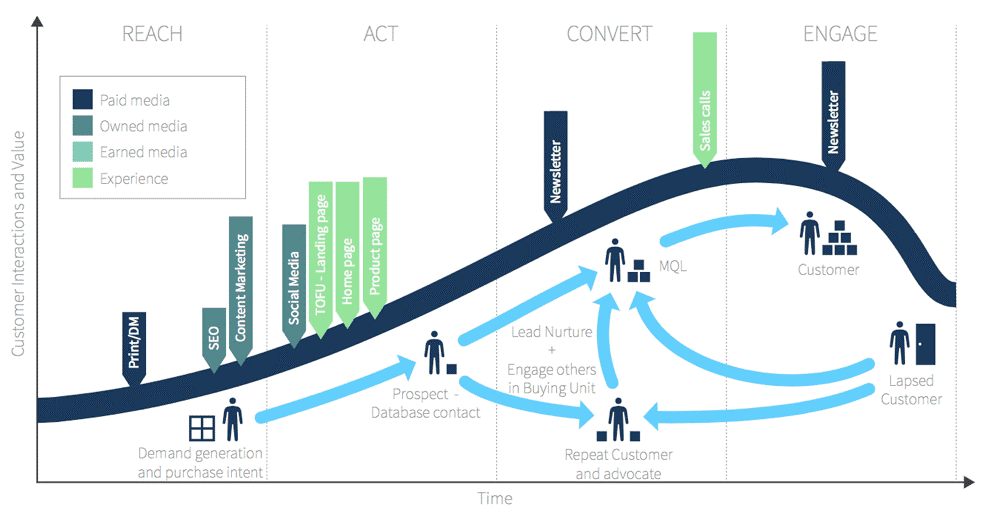
    A way to plan to integrate online marketing into marketing activities is to consider communications from a customer’s point of view through the customer journey. This is often referred to as lifecycle marketing, I recommend you review your use of online AND offline media across the customer lifecycle.

    An example of an audit is shown by this example of the use of marketing activities by a B2B company, which although strong at the top-of-funnel in terms of activities used, is less strong in the middle and bottom-of-funnel nurture and re-targeting activities. Many businesses are adopting marketing automation and account-based marketing technology to implement these touchpoints.

    Trend 2. Conversational marketing

    For me, this is the most exciting trend in marketing today, bringing together rapid consumer adoption of smart speakers and innovation in search query processing, conversational interfaces and messaging.

    “Conversational marketing technologies enable interactions between companies and customers that mimic human dialogue and do so at scale. This category is near the Peak of Inflated Expectations phase”.

    Personally, I think the hype about smart speakers to support the purchase journey is just that. While some products lend themselves to purchase, where a choice is to be made amongst complex products, they just won’t cut it until we have truly intelligent comparison bots. However, the research suggests I may be wrong. A study of 2,000 British adults commissioned by Artefact UK, an AI and data-driven agency, reveals that:

    “Six out of ten smart speaker owners (60%) have used them to make a purchase in the past year. In fact, nearly a quarter (22%) said they have done so within the past week”.

    I believe that building in more relevant to web, email, and mobile-based conversations can have a bigger impact by boosting the relevance and speaking in a more personal tone, this can be achieved through a combination of AI and real-person customer interactions.

    Many platforms now provide analytics to allow you to adjust to the best communication messages, with content and timing.

    Trend 3. Insights-driven marketing

    At Friendlier Organics, we’re huge fans of using analytics and insight to drive business performance and optimize the results from digital marketing. It’s why we’re called what we are, as we love to support organic growth.

    However many small businesses, either do not have the time to interrogate the data or lack the knowledge to get the most out of their stats.

    Improving their data-driven marketing is an aim of many business owners.

    Intensive users of customer analytics are 23 times more likely to clearly outperform their competitors in terms of new customer acquisition than non-intensive users, and nine times more likely to surpass them in customer loyalty.

    Trend 4. Marketing technology

    Today, Marketing Technology (Martech for short) presents a bewildering choice of software services for businesses looking to improve their management of digital media, experiences, and supporting data. If your business and your agencies adopt the right blend of Martech, it can help give you an edge against competitors, but if not, you may be missing out on the insights and automation processes they are using.

    With Martech it is important to clearly identify the goals you wish it to achieve, there is a danger that you can become overwhelmed by choice and suffer paralysis by analysis. This is where a great marketing consultant can support your business as they are not linked to any particular service.

    Trend 5. Consumer Privacy, Trust, and KYC

    Repeated privacy faux-pas by Facebook, Google, and security breaches at other brands leading to the release of customer details have highlighted to consumers that their data isn’t as safe with online brands as they may have once thought. Privacy regulations have been enacted to improve data privacy with increased fines. What are you doing to build digital trust with your customers? Do they feel safe that the data you have stored is sufficiently protected?

    British Airways, was issued with a proposed fine of £183m for a breach of customer data and a £99 million fine on hotel chain Marriott for failing to protect personal data contained in approximately 339 million guest records.

    While these may be more the concerns of the CIO or CFO rather than the CMO, it shows the need for marketers to work with colleagues to mitigate the potential impact of security breaches and reassure customers.

    At the same time, we have seen decreasing effectiveness of traditional identification methods such as cookies for tracking, which makes media ROI determination – supposedly one of the key benefits of digital channels – more difficult.

    Emerging technologies can potentially help with both of these challenges.

    New Identify Management or Know Your Customer solutions are being developed that can both improve security, reduce fraud and improve insight about customers across multiple devices.

    Building trust

    With these consumer concerns and new legislation being updated all the time and the inaccuracy of tracking online with increasing restrictions built into browsers like Chrome and Safari, it seems like the days of the cookie (and particularly third-party cookies) and digital fingerprinting may be numbered. This means that businesses should be considering other alternatives if they aren’t already.

    Trend 6. Digital transformation and Marketing Transformation

    As I mentioned at the start of this blog, many companies run their digital marketing outside of their overall marketing strategy. Problems included a lack of focus on integrated strategy, testing, and a lack of understanding on how to utilize digital marketing effectively.

    Most business owners have had bad experiences with digital marketing due to a lack of knowledge and understanding and have had to trust the third-party provider, only to have their fingers burned.

    More and more small businesses are reaching out to marketing consultants to ensure that third-party providers are implementing their digital strategy correctly. As a business owner, do you have time to read the reports and correlate that all the insights and data are showing progress?

    The aim of digital transformation is to develop a roadmap to improve digital capabilities and skills, while at the same time, integrating ‘always-on’ digital marketing activities with brand and product marketing in the business.

    Despite some talk that we might be in a post-digital world by the end of 2022 and some traditional marketers suggesting that “it’s time to shut down digital marketing for good” the reality is that many specialist third-party provider roles are needed to run digital marketing activities. However, who is managing them?

    A common practice that we can expect to continue in the future is a move to a hybrid approach to marketing and digital marketing, with marketing consultants providing the skills and knowledge to ensure effective marketing.

    All the best for grasping the opportunities from digital marketing such as social media, SEO, website marketing, content marketing, digital advertising, etc in 2022 and beyond!

  • 20 Email Subject Line Best Practices

    20 Email Subject Line Best Practices

    Email marketing has been around for a long time. However when managed correctly it is still one of the most powerful marketing tactics available to you, to achieve business success. Let’s dive in and consider the first impression a reader gets. From experience, a great subject line can transform open rates.

    1. Learn from successful email subject line examples.

    Whenever we’re scratching our heads wondering what to make our subject line, we often look to examples for inspiration. Seeing clever use of wordplay or emojis on one of our favorite newsletters can help us think of new ways to approach our subject line.

    2. Keep it short and sweet.

    Email subject lines will get cut off if they’re too long, particularly on mobile devices. And with up to 46% of email opens taking place on mobile, we recommend using subject lines with fewer than 40 characters to make sure the people scanning your emails read the entire message.

    If you’re struggling to keep your subject lines short, think about which words matter less and where you can remove a frivolous detail. For example, if you’re sending an order confirmation, doesn’t “Your order is being processed” look better than “Order #9435893458358 is being processed”?

    The same goes for your regular emails: Don’t waste your time including the word “update” or “newsletter” in the subject line. Some studies even suggest these words can decrease the message’s open rate since it tells readers the email is associated with a series, and therefore they can catch the next one.

    3. Use a familiar sender name.

    That name recognition we mentioned earlier doesn’t just apply to the famous — it applies to the familiar. When setting your sender name, be as human as you can. is both inviting and unintimidating to people when they open their inboxes.

    If you’ve already met your recipients from a previous conversation, use your own name as the sender’s address — even if the email is technically coming from the company as a whole. The best impression you can make on your customers is that they’re working with you, the individual — not the entire business.

    If the ‘from’ name doesn’t sound like it’s from someone you want to hear from, it doesn’t matter what the subject line is. Ultimately, people are busy, and they simply don’t bother with you if you don’t sound like someone who would make for an easy (or at least friendly) conversation.

    4. Avoid the ‘no-reply’ sender name.

    You would think common sense, but alas I get emails every day with no-reply. Your customers will receive large amounts of spam, therefore hesitate to open emails from unfamiliar senders. And, even fewer people like talking to a robot. Think about when you call a company and can’t get a hold of an actual person. It’s frustrating, right? This goes for email, as well.

    Never use “.” I repeat: Never use this email address. Not only does it make it look less personable, but it also stops people from adding your email to their address book.

    5. Use personalization tokens.

    Remember the personalization we mentioned earlier? Using personalization tokens — like name or location — in the subject line adds a feeling of rapport, especially when it’s a name. Everyone loves the sound of their own name. Plus, it increases clickthrough rate: In fact, research has shown that emails that included the first name of the recipient in their subject line had higher click-through rates than emails that did not.

    Another personalization tactic that works is to tailor subject lines to the recipient’s location — things like lists of their respective cities’ best outdoor bars and restaurants.

    Just don’t go overboard with the personalization here. That can be a little creepy. But little personalized touches show that you know more about your recipients than just their email address. However, if you can’t (or don’t want to) use personalization tokens in the subject line, use “you” or “your” so it still sounds like you’re addressing them directly.

    6. Segment your lists.

    Failing to segment is a reason why email marketing can fail. While email blasts that go out to your entire list might be relevant and helpful to some people, it won’t be to others — and could cause confusion or frustration. Why is this restaurant sending me a list of the best local steakhouses when I’m a vegetarian? Why is this company sending me case studies when I just signed up for its email list yesterday?

    Personalize the experience using information from the actions your customers have already taken — from which forms they’ve filled out, to which industries they’re in, to what their personal preferences are. In email marketing, you can personalize your recipients’ experience using a little thing called list segmentation.

    7. Don’t make false promises.

    Your email subject line is making a promise to your reader about what you will deliver in your message. Make sure that you make good on that commitment — and do not try to get your email opened by making false promises. This will irk your audience, and they’ll learn not to trust your subject lines, resulting in a lower open rate and a higher unsubscribe rate.

    8. Do tell them what’s inside.

    Speaking of making promises, if your visitor has downloaded an offer and you’re delivering it via email, it’s a great idea to use a subject line that says something like, “Your new ebook inside!” or, “Your guide awaits!” This works better than a simple “thank you” in the subject line because it makes it clear that something is waiting inside the email.

    9. Time it right.

    Sending an email at the right time with the right subject line can make a huge difference in open and click-through rate. A prime example? When food publication Eater sends at 6:45 P.M. on a Wednesday evening that said, “Where to Drink Beer Right Now” — just in time for happy hour. Nailed it.

    Another favorite example is a classic email from Warby Parker with the subject line, “Uh-oh, your prescription is expiring.” It was sent two weeks before the recipient needed to renew his prescription. By sending an email at the right time, Warby Parker increased the chances of their email getting opened — and included a relevant call-to-action about getting a glasses upgrade, too.

    10. Use concise language.

    Keep in mind that people scan their inboxes very quickly — so the more clear and concise your subject line is, the better. It’s usually a lot better to be concise than it is to use complex and flowery language — unless you’re going for an elusive subject tone to entice your recipients.

    When you’re going for a concise subject line, think about how your email will benefit your recipients. You’ll want to make that benefit very clear. For example, “Increase your open rates by 50% today” is more appealing than “How to increase open rates.”

    11. Start with action-oriented verbs.

    Subject lines are similar to calls-to-action, in that you want the language to inspire people to click. Subject lines that begin with action verbs tend to be a lot more enticing, and your emails could be drastically more clickable by adding a vibrant verb at the beginning.

    Actionable subject lines will inspire people to click on your email by instilling urgency and excitement. For example, in an email inviting people to a hockey legend dinner, the email subject line might read, “Dine with Bruins legend Bobby Orr,” rather than a more generic (and less actionable) “Local Boston Sports Legend Meal.” The former email uses “Dine” to help the reader envision themselves at a dinner table.

    12. Make people feel special.

    The psychology of exclusivity is a powerful thing. When people feel like they’re on the inside, it gives them a sense of belonging which builds loyalty and compels them to convert on your emails.

    The right phrasing can make your recipients feel special — and the effect can be magical. A few ideas for phrasing include:

    • “For our beloved customers only”
    • “An exclusive offer for you”
    • “My gift to you”
    • “You’re invited!”
    • “Private invite”

    13. Create a sense of importance.

    There’s a phrase that, for many of us, is reminiscent of classic infomercials: “Act now!”

    And while we wouldn’t encourage using that exact language in your content, we do agree that communicating urgency and scarcity in an email subject line can help compel readers to click (or act) — when phrased creatively and strategically.

    But because you don’t want to be known as “the brand that cried wolf,” use these subject lines sparingly, and try to limit them to when the occasion genuinely calls for immediate action.

    14. Use numbers.

    A lot of businesses send emails with vague statements in their subject lines — which is why using data and numbers is a great way to get your emails noticed, demonstrate a clear and straightforward message about your offer, and set the right expectations.

    Just like with blog titles, using numbers in your subject line is an effective email marketing best practice. You might use numbers to refer to the title of your listicle, the page length of an offer, a specific discount, or the numerical benefit of a particular resource you’re providing — like “Join more than 750 others at this event!”

    15. Pose a compelling question.

    Asking a question in your subject line can also draw readers in — especially if you’re asking a question you know is relevant to your recipients’ buyer persona. This is just one way to pique that curiosity we mentioned earlier. For example, you might try the following: “Are you making these SEO mistakes?” or “Do you know what your website is doing wrong?”

    Zillow once sent an email with the subject line, “What Can You Afford?” that linked to a website showing apartments for rent. A subject line like this is both encouraging and a touch competitive: While it gives hope that there are apartments out there that’ll fit within your budget, it also pits your cash against what the market offers.

    16. Don’t be afraid to get punny.

    Most people love a good pun. It’s a great way to delight your recipients and spice up your emails. Some of the best punny email subject lines come from JetBlue, with subject lines like “Land wander-ful low fares now!”

    Quirky — a community-led invention platform — worded one of its email subject lines like this: “Abra-cord-abra! Yeah, we said it.” That second part is conversational and self-referential — and exactly what most people would say after making a really cheesy joke in real life.

    If you’re the least bit punny, think about small ways you can slip them into your emails when it’s appropriate. Just don’t overdo it. And remember the rule: When in doubt, ask a coworker.

    17. DON’T USE ALL CAPS or overuse exclamation points!!!

    A subject line that says, “OPEN NOW AND RECEIVE A FREE TRIAL” or, “50% off coupon today only!!!!!!!!” isn’t going to get your email opened. If anything, it’ll probably get your email ignored.

    18. Don’t include a question and exclamation in the same subject line.

    Here’s a subject line that can automatically wind up in a recipient’s spam folder: “Want a solution fast? Act now!”

    The fast solution isn’t the problem in the example above. It’s also not “act now” — although those are known email marketing spam words. It’s both phrases together. This is a classic email saboteur, and it comes in many forms. All you need is to ask and yell at the same time.

    19. Use engaging preview text.

    While preview text isn’t technically part of your subject line, it does appear right near the subject line — and it certainly deserves your attention.

    Preview text provides recipients with a peek at the content inside your email, which email clients like the iPhone Mail app, Gmail, and Outlook will display alongside the subject line. (The exact amount of text shown depends on the email client and user settings.)

    20. A/B test your subject lines.

    Although these tips and best practices are a great place to start, what works best for some companies may not work as well for others. It’s all about figuring out what works best for your specific audience. That’s where A/B testing comes in.
    While it can be tempting to use your intuition to predict what subject line language will make people click on your emails, you should always A/B test your highest-stakes subject lines, and tweak the wording according to your results. What works best for your audience: Long or short subject lines? Including numbers or not including numbers? Questions or statements?

    To summarise, ask yourself the question, why would my customer open this email, what benefit is it to them? Answering that question and applying the above will see an increase in your open rates.

    As business and marketing consultants we can advise and guide you to improve your email marketing.

    Book Your Free Consultation.

  • What makes a good email subject line?

    What makes a good email subject line?

    Why do we need a good subject line? Each email you send gets one chance of making a great impression. The subject line and snippet is your email’s chance to make a great impression. Each email is a fresh impression, regardless of how many you have sent previously.

    Regardless of your goals, these are the essential elements that your subject line should possess:

    1. Urgency

    Creating a sense of urgency is an efficient way to get people to take action. You can create a similar effect in your subject lines strategically.

    By communicating a known start and end date to a special sale or promotion, viewers scrolling through their inbox will click to see what they can get in that window of time. This is also a good practice when done in a small series of emails counting down the window of opportunity — as long as you’re not flooding their inbox and coming off spammy.

    2. Curiosity

    Sometimes, subject lines work because of their ability to send the message, “You will benefit from opening this email.” But other times, it’s good to maintain some sense of mystery — especially if it pique’s the recipient’s natural curiosity and interest. Because they require opening the email to get more information, they can result in, well, a higher open rate. But make sure the subject line, while enigmatic, still aligns with your brand. Too obscure, and it could end up being seen as spam.

    3. Offers

    Here’s where that benefit of opening a given email comes in. At the end of the day, people love new things and experiences — especially when they’re free, or at least discounted. Open with that by including it in your subject line. Personally, I’m much more inclined to open my daily newsletters when there’s an offer or allusion for “free stuff” directly mentioned in my inbox.

    4. Personalization

    No two email subscribers are the same — and, sometimes, that means the emails you send to them shouldn’t be, either. At this point, marketers have never had more ways to learn about their subscribers’ preferences, jobs, or general (dis)likes. So when you send them content, on occasion, make it catered toward the individual.

    5. Relevance and Timeliness

    When we subscribe to an email list, it’s usually because we want to be kept informed, or at least learn more about a given topic (more on that later). Similar to piquing your audience’s curiosity, crafting email subject lines that incorporate trending topics or timely headlines can help you establish your brand as an authority within your industry — and can compel people to click to read.

    6. Name Recognition

    Let’s face it: We all have famous people who, at some point, we presently or previously have admired. And when you understand your audience’s preferences and interests, you can pique their interest by including the names of these admired, recognizable individuals by including them in your content — and mentioning them in your email subject lines. But take heed: This tactic really only works when it aligns with your brand, product, or service. So keep it relevant, rather than just throwing out a name for the sake of recognition.

    7. Cool Stories

    At the risk of sounding like a broken record, here’s another place where curiosity comes into play. By front-loading your email subject line with a compelling allusion to a story — but can only be read if opened or clicked — your audience is likely to become intrigued, and want to learn more. Again, make sure the story is relevant to your brand. Otherwise, it might just confuse your readers and prevent them from opening the email.

    As with all forms of marketing communication, email marketing works best, when it delivers consistent correct communication. This is achieved by measuring and managing the process.

    Need a hand achieving your marketing goals, reach out for a free consultation.

    We will identify what you need to know but perhaps do not know.

    Book Your Free Consultation.

  • Repositioning Stress

    Repositioning Stress

    How to manage stress better!
    By Janine Fulla, Yellow Rose Life Coaching

    Here at Friendlier Organics we look at all aspects of your business to ensure growth. One of the key elements are the people within your organisation. We often team up with experts like Janine to ensure the right people are in the right place to support your business. Janine has kindly written this article on repositioning stress.

    One thing for sure, is that we have all felt stress at one time or another, no one is immune to it.  The big question is how do we manage it?  Even thinking about that question can be stressful, am I right?

    Stress is important to manage, for if we don’t it can cause all sorts of other health issues both mentally, such as; fear, anxiety, depression, and physically, such as; headaches, shortness of breath, body pain, and heart health issues.

    Often after a difficult day, we look forward to a quick fix from the stress and crack open a cold one or pour a nice glass of wine, sit in a comfy chair and exhale.  The only problem is, this is a temporary solution.

    Countless events in our life can create stress.  What amplifies our stress is our thoughts and stories we tell ourselves. 

    Why? We are programed to receive negative thoughts, and they can manifest. 

    Have you ever thought about something that bothers you or makes you angry, and the more you think about it, the bigger it gets and the more angry you feel?

    It’s perpetual. 

    The wheel in the hamster cage is turning…but the hamster is dead.

    I can’t begin to tell you how many times I have let my thoughts get out of control and created more stress by putting them on auto repeat, so each time they filter through my mind, it’s worse than the time before, and soon my negative consuming thoughts paralyzed me. 

    Un-managed thoughts and stress can create havoc in every area of your life, and you may not even be aware of what you are leaving to others in your wake. 


    Often, we blame the circumstances we are in for the stress.  In reality, it’s not the circumstance, it’s the thoughts we think about the circumstance that creates the stress.

    The greatest weapon against stress is our ability to choose one thought over another.

    Our thoughts create our feelings.

    Our feelings drive our actions or inactions.

    Our actions or inactions create our results.


    How do we manage stress better?

    By learning to change our thought pattern and to see stress from a different point of view or perspective, we can begin to change the stories, which accompany our thoughts.  Remember, you get to decide the stories that you believe in.

    By eliminating blame on our circumstances, which we cannot control, we can choose to accept our circumstances, and train our mind to receive more positive thoughts.

    So, the next time you are feeling stressed, take a moment to tune into your thoughts and circumstances to see if you can consciously change your perspective on either.  Sometimes a little awareness can go a long way in making us feel better.

    We can plant weeds in our mind or beautiful flowers, it’s a choice.

    Learning to manage stress is crucial to our well-being.  As a Life Coach, I can help you become aware of your thoughts and patterns, and help you turn them around so you can get back to life in a more positive, confident, productive,  stress-free way.

    If you, or you know someone that would benefit in managing their stress, I encourage you to reach out to me by simply replying to this email.  I offer a safe place to talk, a place to be heard, a way to overcome obstacles, and a path for personal growth.

    I encourage you to send or share this newsletter with your friends.  They can sign up to receive InSights by replying to this email, or visiting my website.

    Thank you for sharing, and thank you for caring.

    Stay safe and be kind,

  • Why it is worth your business offering a guarantee.

    Why it is worth your business offering a guarantee.

    When it comes to running a business and securing clients, one thing is for sure; your clients and customers will want to feel that they can trust the service or product that you can offer them. 

    Trust can be hard to build; however, the good news is that there are a variety of ways that you can try to ensure that your clients have faith that you will be able to deliver what they need.

    One approach that you can take is to offer some form of a guarantee. There are a wealth of guarantees out there to choose from. Here are some of the most commonplace to help you work out which will work best with your services or products. 

    Money Back

    One of the most common guarantees that you are likely to see is one that is “money back”. Many people see that this is just their everyday rights regarding buying an item or signing up for a service, rather than an additional benefit offered by the company. This doesn’t mean that you should give up on this idea; in fact, it can be one of the most basic offerings that you can give your customers and shows them that you are taking their rights as a consumer into consideration. 

    Lifetime guarantee

    If you have a product that is known for being long-lasting and durable, then a lifetime guarantee might be the right choice for you. Examples of some of the brands that offer this level of guarantee include Doc Marten and Eddie Bauer. Both of whom are known for being able to provide exceptional quality to their customers. 

    Try before you buy

    Another common type of guarantee is allowing your potential customers or clients to try you out before committing to buying. This is particularly commonplace with online retailers, who may find that their audience feels concerned about diving in to make a purchase before they fully know what to expect from them.

    This type of guarantee also serves as a way to make sure that whatever it is that you offer will be suitable for the customer. You will often see mattress suppliers provide this type of guarantee, as they know that comfort is going to be vitally important for their success. 

    Price match

    Not every guarantee is around the quality of the item, how long it will last or whether it is fit for purpose. Another thing that you can offer is the best price guarantee. This type of guarantee means that, given a product comparison, if someone finds the same product as yours at a lower price, you will match it.

    For the most part, this particular guarantee is offered when the market is competitive as it may give you an edge over your competitors. 

    The type of guarantee that you offer will depend on the nature of your business and what you think will appeal the most to your audience. No matter what you pick, one thing is for sure, and if you do decide to offer a guarantee, then the chances are that you are going to appeal to a whole new audience and secure yourself some new customers in the meantime. 

    As always if you need support with identifying business growth strategies such as these then please reach out and connect.