If you asked 50 business owners in Nanaimo you would get 50 different answers. If you combine the Chartered Institute of Marketing and the American Marketing Associations definition it would be could be defined as follows:
“Marketing is the activity, set of instructions, and processes for creating, communicating, delivering, and exchanging offerings that have value for customers, clients, and stakeholders at large.”
However, what does this actually mean to the small business in Nanaimo? Breaking it down, activity is not only the promotional activity such as Logo design, digital marketing, social media marketing, etc. but any activity your business undertakes that sends a message, this will include customer care, how you deliver (or not) your offering, any follow-up post offering. It also involves the intrinsic communications that you send to customers, often referred to as your brand values and brand reputation, the real why you do what you do, that is not financially related.
With this in mind, marketing also has an internal element, your people and processes will send a more powerful message than any promotional activities you might undertake. Consider a member of staff having poor interactions with customers, versus a google AdWords campaign. Which will impact greater on the sustainable success of your business?
Here at Friendlier Organics we are passionate about all aspects of marketing and believe it is a principle that should be at the core culture of all businesses, rather than just a promotional function.
We understand that not everyone can be the ultimate best or the cheapest, however, when considering the 4 P’s of your marketing mix, you can be the best within your brand/business positioning. For instance, you can be the best customer care within your price bracket.
Marketing in its modern form has been around since In the 1960s with Philip Kotler, and E Jerome McCarthy developing marketing theories over 60 years ago. The mediums may have changed from Print, Radio, and TV to social media, Google My Business, and websites but the theories hold strong.
As a starting point, you can review your business’s 4 Ps.
Product
Let’s say you come up with an idea for a product you want your business to sell. What’s next? You probably won’t be successful if you just start selling it.
Instead, you need your marketing team, which may be you, to do market research and answer some critical questions: Who’s your target audience? Is there a sufficient market fit for this product? What messaging will increase product sales, and on which platforms? How should your product developers modify the product to increase the likelihood of success? What do focus groups, if you do not have the budget for a focus group, you could ask friends and family who fit with your customer demographic, think of the product, and what questions or hesitations do they have?
Marketers and business owners use the answers to these questions to help businesses understand the demand for the product and increase product quality by mentioning concerns stemming from focus group or survey participants.
Price
Your marketing team will check out competitors’ product prices, or use focus groups and surveys, to estimate how much your ideal customer is willing to pay. Price it too high, and you’ll lose out on a solid customer base. Price it too low, and you might lose more money than you gain. Fortunately, marketers can use industry research and consumer analysis to gauge a good price range.
Place
It’s critical that your marketing department, again this might be you, uses their understanding and analysis of your business’s consumers to offer suggestions for how and where to sell your product. Perhaps they believe an eCommerce site works better than a retail location, or vice versa. Or, maybe they can offer insights into which locations would be most viable to sell your product, either nationally or internationally.
Promotion
This P is what most consider to be marketing, it is likely the one you expected from the get-go: promotion entails any online or print advertisement, event, or discount your marketing team creates to increase awareness and interest in your product, and, ultimately, lead to more sales. During this stage, you’ll likely see methods like public relations campaigns, advertisements, or social media promotions.
Hopefully, our definition and the four Ps help you understand marketing’s purpose and how to define it. Marketing intersects with all areas of a business, so it’s important you understand how to use marketing to increase your business’s efficiency and success.
Unsure if all your 4P’s of marketing are sending out the same messages to your clients and stakeholders then please book an initial marketing consultation.
In the business and marketing world, pulling the plug on a campaign can be extremely difficult, especially when you and others have put time, money, and energy into a marketing campaign. This is why many hire marketing consultants to provide an impartial view of your campaigns without emotional attachments.
If you do not have a marketing consultant, here are 10 signs it might be time to pull the plug on your marketing campaign.
Why Stop a Marketing Campaign?
You should stop a marketing campaign if you’ve given it enough time and there’s still no sign of success. A business might also stop a marketing campaign if the metrics don’t add up or if the campaign isn’t resulting in quantitative business growth.
10 Signs It’s Time to Stop Your Marketing Campaign
No two campaigns are the same, but these ten signs indicate that it’s time to stop a marketing campaign.
1. If you’re not getting enough value
How do you know whether a marketing campaign is giving you enough value? Well, ask yourself:
Are you going to break even on the money you’ve spent?
Does the cost far exceed the value you’ll get?
If the numbers don’t add up, it might be time to stop the campaign.
2. If you’ve given enough time
Marketing campaigns require patience. Sometimes, you might not even see the results from certain campaigns in months.
However, if your marketing campaign takes way longer to generate positive results when compared to other campaigns of its kind, then it’s time to pull the plug. Always measure like with like.
3. Your optimizations don’t change anything
Suppose, in a bid to save a campaign, you begin to optimize different elements but still don’t notice any improvements; then, you should end the campaign.
You’d be better off spending your time and resources on other campaigns or revenue-generating activities.
4. It’s cheaper to stop now
If you’ll save more time and money by pulling the plug now rather than later, then that’s a sign the campaign needs to end right away!
5. When you’ve tried your best
If you and the team have tried all methods and tricks in the book to no avail, then it might be time to resign and move on with some pride left.
6. If you’re getting negative results
You know it’s time to pull the plug on your campaign if your weekly reports mostly contain red downward arrows instead of the green upward arrows
7. If other campaigns are working
You’re likely running more than one campaign at the same time. If you notice that all of your other campaigns generate the results you want, it’d be smart to drop the underperforming campaigns.
8. When your campaign sends the wrong message
Even the most well-meaning marketing campaign can get a ton of backlash from the public. Whenever a campaign is met with such a negative response, it’s best to unplug the campaign and go back to the drawing board to whip up a new one.
9. You’re getting the wrong clients
You should consider stopping your campaign if you’re engaging the wrong audience and attracting not-so-ideal clients.
For instance, if your goal is to get giant corporations, but you’re inundated with SMEs, then you should have a hard look at your campaign.
10. You’re missing timelines
When creating a campaign, you should tie results to a specific timeline. If you find that you and your team are consistently having difficulties sticking to a campaign’s timeline, then you might need to pull the plug.
What to Expect When Your Marketing Campaign Ends
Here are some things a business should expect when it stops an effective marketing campaign:
A drop in the number of leads and acquisitions
Lower impressions on social media
A decrease in search traffic
Inability to maintain growth
Therefore, if you have to stop a marketing campaign, you should have a backup plan in place. Have another campaign ready to go as soon as you stop an unsuccessful campaign.
Ready to Pull the Plug?
Although successful marketing campaigns usually take time to mature, it’s essential to know when you’re wasting valuable time and resources.
If the campaign’s cost exceeds its value, attracts the wrong clientele, or downright loses money you’ll never recoup, then it’s time to stop the marketing campaign. With the insights provided in this article, you should be able to determine whether to pull the plug or not.
Still unsure if it is time to end any of your marketing campaigns, reach out for an independent point of view.
Attracting employees to your company has the same principles as marketing your business. The difference is a change of audience, a change of message, and perhaps a change of the medium.
What is the difference between recruiting and business development? Here at Friendlier Organics, they go hand in hand, most businesses will need to recruit and hire staff to achieve business development, even if you are a gig economy company such as Uber etc.
Every time you put your company ‘out there, whether you are running a promo or posting a job, people form an impression of you. With recruitment, you have to convince your audience that what you are communicating and selling—a place in your company—is right for them.
Currently, it seems like everyone is hiring, so how do you cut through a noisy job marketplace and draw the best candidates to your business?
Read these five tips to successfully build your team.
1. Know what you want
Start with clearly identifying what the business needs. For most businesses, this is a great opportunity to carry out a gap analysis and find the right person for a job rather than just replace. What a specific job role means to you will be different from what it means to someone else. It is not just about skills and qualifications but also a good fit for your existing team, and other qualities. If you run a window-washing service, your top candidate might be “efficient and quick` mover”; if you are bringing on board a customer service representative, a “good listener and quick thinker” may be more of what you need.
It is good to avoid hiring someone just because you think they are like you. Certain differences can be a good thing and a source of fresh ideas. What’s key is for the candidate to fit the role, and not to change the role to fit the employee.
2. Search the right places
Once you are clear on your needs for an employee, you have to figure out where to look for it, this is where you will need to think outside the existing box, of indeed. If you’re seeking a recent graduate you’ll want to contact local universities or colleges. LinkedIn can be a great source for a wide range of professionals. Depending on who you’re looking for, you may need to try different channels. Your customer base could be an exceptional resource.
3. Set yourself apart
When you’re posting a position, aim to communicate what differentiates you from your competitors. As with marketing carry out a competitor analysis and base, it on their job adverts. When it comes to writing a posting, rather than give a laundry list of duties (the old, “the successful candidate will…”) try to paint a picture of what working in your business will be like. How does a typical day go for someone in that role? What will they start doing and where could they end up six months from now? Create a story in the mind of any potential candidates.
4. Let your employees be your ambassadors
No job board will sell your company as your employees can! If you really want your people to spread the word to their networks, you can even offer incentives for references. It can be worth it: Candidates referred by your own staff are more likely to be better employees and stay longer than random applicants.
5. Tailor your pitch to the person
When you’re ready to talk to a candidate, be sure to listen for what they’re looking for career-wise. Top performers don’t just want a job—they usually have career goals of their own and want to know how you can help them achieve their objectives.
Don’t be afraid to promote what your company has to offer, but at the same time be honest. There’s no point promising something you can’t provide, because they’ll find out sooner or later and may choose to move on when they do.
Approaching top talent on social media
A lot of companies post jobs on various social media platforms, such as Linkedin, Facebook, etc. However, you can also turn the search around and use social media to find people who would be good for your company.
If you’re approaching someone on social media, let them know why you’re contacting them, e.g.: “I saw on your LinkedIn profile you have lots of experience building apps for the construction industry. My company develops software for the sector and I wondered if you’d be interested in talking…”
And remember—you’re marketing yourself! Even if the person isn’t interested, thank them for their time and ask if they might know someone. Reaching out this way builds both your network and your brand.
Finally, a good strategy is to be always recruiting, what I mean, share your successes and team efforts, when you are ready to hire, potential clients will have been watching.
Do you need some help with your recruitment strategies? Then please reach out for a free consultation.
As business owners we are constantly battling marketing blindness, especially with digital marketing. How do you stop your audience scrolling past your content and stay on brand. We were asked by Curtis of Gorilla Property Services of Nanaimo to explore what AI would produce and still stay on brand.
Here are the initial results. Please note these will probably be changed so follow us and them on Facebook and Instagram to see the final results.
Krista approached us to help kick-start her marketing. We started by reviewing the current marketing activities against existing business goals. We then helped identify key customer demographics and the solution they required.
As part of the project, we reviewed which marketing strategies would give a greater ROI and which were short and long-term.
We currently manage their SEO marketing in-house, along with their PPC for Google Adwords. We work with their other providers such as social media marketing, video marketing, and content marketing to ensure all the 4 P’s of marketing are sending out consistent correct communications.
We meet with the CEO and Operations Manager once a month to review the effectiveness of marketing activities and make recommendations for future marketing activities, including People and Processes.
In this blog, we will explore six key marketing trends that many businesses are currently applying to ensure sustainable growth.
It is very clear that digital marketing has made a huge impact over the last decade, and more. You only have to look at the advertising spend on Google and Facebook/Instagram. It is important at this point to mention that implementing an integrated marketing strategy will show the best results and support your digital marketing efforts.
Trend 1. Lifecycle marketing
The “funnel” has been around for decades, it is not something new, despite the claims of many self-proclaimed digital marketing gurus. Digital marketing provides sufficient data to fine-tune this tunnel, assuming you can interpret the huge amount of data and make informed decisions.
Although, recently, many marketing gurus are now claiming that the ‘funnel is dead’ since consumer follows non-linear journeys, regardless of the product or service you’re involved with marketing.
It will always be the case that to successfully grow a business, your primary focus is growing awareness, closely followed by increasing a customer’s desire for your product or services, which leads to action on their part. This journey may take seconds or weeks depending on the complexity of the purchase.
The role of digital marketing should be to create a unified customer experience, which can be utilized to maximize your existing customers in growing your business.
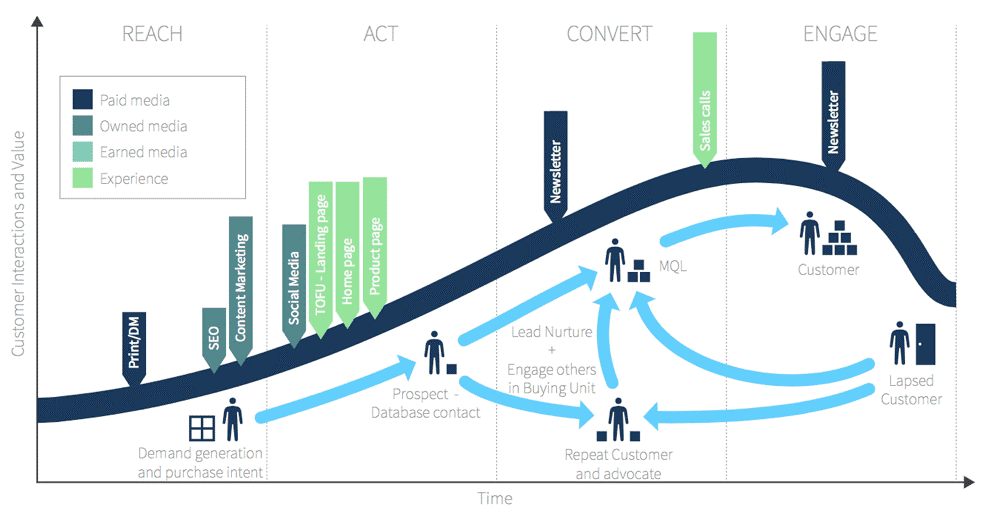
A way to plan to integrate online marketing into marketing activities is to consider communications from a customer’s point of view through the customer journey. This is often referred to as lifecycle marketing, I recommend you review your use of online AND offline media across the customer lifecycle.
An example of an audit is shown by this example of the use of marketing activities by a B2B company, which although strong at the top-of-funnel in terms of activities used, is less strong in the middle and bottom-of-funnel nurture and re-targeting activities. Many businesses are adopting marketing automation and account-based marketing technology to implement these touchpoints.
Trend 2. Conversational marketing
For me, this is the most exciting trend in marketing today, bringing together rapid consumer adoption of smart speakers and innovation in search query processing, conversational interfaces and messaging.
“Conversational marketing technologies enable interactions between companies and customers that mimic human dialogue and do so at scale. This category is near the Peak of Inflated Expectations phase”.
Personally, I think the hype about smart speakers to support the purchase journey is just that. While some products lend themselves to purchase, where a choice is to be made amongst complex products, they just won’t cut it until we have truly intelligent comparison bots. However, the research suggests I may be wrong. A study of 2,000 British adults commissioned by Artefact UK, an AI and data-driven agency, reveals that:
“Six out of ten smart speaker owners (60%) have used them to make a purchase in the past year. In fact, nearly a quarter (22%) said they have done so within the past week”.
I believe that building in more relevant to web, email, and mobile-based conversations can have a bigger impact by boosting the relevance and speaking in a more personal tone, this can be achieved through a combination of AI and real-person customer interactions.
Many platforms now provide analytics to allow you to adjust to the best communication messages, with content and timing.
Trend 3. Insights-driven marketing
At Friendlier Organics, we’re huge fans of using analytics and insight to drive business performance and optimize the results from digital marketing. It’s why we’re called what we are, as we love to support organic growth.
However many small businesses, either do not have the time to interrogate the data or lack the knowledge to get the most out of their stats.
Improving their data-driven marketing is an aim of many business owners.
Intensive users of customer analytics are 23 times more likely to clearly outperform their competitors in terms of new customer acquisition than non-intensive users, and nine times more likely to surpass them in customer loyalty.
Trend 4. Marketing technology
Today, Marketing Technology (Martech for short) presents a bewildering choice of software services for businesses looking to improve their management of digital media, experiences, and supporting data. If your business and your agencies adopt the right blend of Martech, it can help give you an edge against competitors, but if not, you may be missing out on the insights and automation processes they are using.
With Martech it is important to clearly identify the goals you wish it to achieve, there is a danger that you can become overwhelmed by choice and suffer paralysis by analysis. This is where a great marketing consultant can support your business as they are not linked to any particular service.
Trend 5. Consumer Privacy, Trust, and KYC
Repeated privacy faux-pas by Facebook, Google, and security breaches at other brands leading to the release of customer details have highlighted to consumers that their data isn’t as safe with online brands as they may have once thought. Privacy regulations have been enacted to improve data privacy with increased fines. What are you doing to build digital trust with your customers? Do they feel safe that the data you have stored is sufficiently protected?
British Airways, was issued with a proposed fine of £183m for a breach of customer data and a £99 million fine on hotel chain Marriott for failing to protect personal data contained in approximately 339 million guest records.
While these may be more the concerns of the CIO or CFO rather than the CMO, it shows the need for marketers to work with colleagues to mitigate the potential impact of security breaches and reassure customers.
At the same time, we have seen decreasing effectiveness of traditional identification methods such as cookies for tracking, which makes media ROI determination – supposedly one of the key benefits of digital channels – more difficult.
Emerging technologies can potentially help with both of these challenges.
New Identify Management or Know Your Customer solutions are being developed that can both improve security, reduce fraud and improve insight about customers across multiple devices.
With these consumer concerns and new legislation being updated all the time and the inaccuracy of tracking online with increasing restrictions built into browsers like Chrome and Safari, it seems like the days of the cookie (and particularly third-party cookies) and digital fingerprinting may be numbered. This means that businesses should be considering other alternatives if they aren’t already.
Trend 6. Digital transformation and Marketing Transformation
As I mentioned at the start of this blog, many companies run their digital marketing outside of their overall marketing strategy. Problems included a lack of focus on integrated strategy, testing, and a lack of understanding on how to utilize digital marketing effectively.
Most business owners have had bad experiences with digital marketing due to a lack of knowledge and understanding and have had to trust the third-party provider, only to have their fingers burned.
More and more small businesses are reaching out to marketing consultants to ensure that third-party providers are implementing their digital strategy correctly. As a business owner, do you have time to read the reports and correlate that all the insights and data are showing progress?
The aim of digital transformation is to develop a roadmap to improve digital capabilities and skills, while at the same time, integrating ‘always-on’ digital marketing activities with brand and product marketing in the business.
Despite some talk that we might be in a post-digital world by the end of 2022 and some traditional marketers suggesting that “it’s time to shut down digital marketing for good” the reality is that many specialist third-party provider roles are needed to run digital marketing activities. However, who is managing them?
A common practice that we can expect to continue in the future is a move to a hybrid approach to marketing and digital marketing, with marketing consultants providing the skills and knowledge to ensure effective marketing.
All the best for grasping the opportunities from digital marketing such as social media, SEO, website marketing, content marketing, digital advertising, etc in 2022 and beyond!
Cory asked us to support his team with Digital Marketing and Social Media coaching. We audited the team’s current activity and made recommendations based on business objectives. Cory and his team reach out as and when needed for marketing support.
We have teamed up with Aislinn Bissenden a Wealth Manager from Integral Wealth to bring you five amazing reasons you should be making the most of your RRSP
What is an RRSP?
A Registered Retirement Savings Plan (RRSP) is a retirement saving and investing vehicle for employees and the self-employed in Canada that you can contribute to for retirement purposes.
RRSPs have two main advantages. First, any money you contribute to your RRSP can be deducted from your taxable income, which reduces the amount of tax you must pay. Second, while your money remains within the RRSP all the growth is tax-deferred until you begin to withdraw the funds in retirement when your tax rate may be lower than during your working years.
How does it work?
You start earning RRSP contribution room once you start working and filing your taxes with CRA. The maximum amount you can contribute to an RRSP any year is 18% of the income you earned the previous year up to a maximum, whichever is smaller. Even if you don’t use the full amount of your available contribution room, you have the benefit of carrying this amount forward to be used in future years.
Contributions to an RRSP reduce your taxable income and may produce a tax refund which can then be used to pay down debt, save for a child’s education, or to pursue other financial goals. Once you’ve made your contributions you can then invest the money in a variety of financial products like stocks, bonds, mutual funds, or GICs, and any investment earnings you make are tax-sheltered until you withdraw the funds from that account.
You can contribute to an RRSP up to the end of the year you turn 71. At that time, you must transfer your RSP to an RRIF or a Life Annuity which are designed to provide you with retirement income.
Main Benefits of Contributing:
Tax reduction – contributions into an RRSP reduce your taxable income. For example: Your taxable income is $75,000 and you contribute $10,000 into an RRSP. Your taxable income drops down to $65,000 and you’re saved from paying taxes on the $10,000 this year.
Tax Sheltered Growth – you don’t pay tax on any investment earnings in your RRSP until you withdraw the funds. Compounding interest helps the funds within your RRSP grow at an expedited rate.
Tax Deferment – The goal is to contribute to your RRSP during your higher income earning years when you’re in a higher tax bracket and then withdraw the funds once you have stopped working and are earning less income, so your money is taxed at a lower rate.
Creditor Protection – In British Columbia, RRSP’s are fully protected assets from Creditors.
Creating a pension for yourself in retirement. Typically as a business owner, you do not have the luxury of having a company pension to rely on to help you pay for retirement. By contributing regularly and choosing the right investments you are building financial stability for your future self.
There are many ways you can take advantage of your RRSP. They are a flexible tool that can help you pay less tax and save for long-term goals. To make the most of your RRSP, I always recommend you talk to an expert, someone who can look at your personal financial situation and help you create a strategy to achieve your goals.
The deadline for contributing to reducing your taxable income for 2021 is March 1, 2022.
A huge thanks to Aislinn for sharing her knowledge and understanding of RRSPs.
Owner Darren and Lisa were recommended and referred to Friendlier Marketing by two existing marketing clients, Karve Solutions and Amrok Services. Darren wanted to increase the presence of Krasy Joe’s digital online presence to a higher level. We carried out a basic branding exercise and a digital audit. This helped identify a strategy to increase the online presence. We built a customer-friendly website and provided a rotating digital marketing action plan for them to implement.
We left Darren and Lisa with a digital marketing growth strategy so they could implement the tactics.
Email marketing has been around for a long time. However when managed correctly it is still one of the most powerful marketing tactics available to you, to achieve business success. Let’s dive in and consider the first impression a reader gets. From experience, a great subject line can transform open rates.
1. Learn from successful email subject line examples.
Whenever we’re scratching our heads wondering what to make our subject line, we often look to examples for inspiration. Seeing clever use of wordplay or emojis on one of our favorite newsletters can help us think of new ways to approach our subject line.
2. Keep it short and sweet.
Email subject lines will get cut off if they’re too long, particularly on mobile devices. And with up to 46% of email opens taking place on mobile, we recommend using subject lines with fewer than 40 characters to make sure the people scanning your emails read the entire message.
If you’re struggling to keep your subject lines short, think about which words matter less and where you can remove a frivolous detail. For example, if you’re sending an order confirmation, doesn’t “Your order is being processed” look better than “Order #9435893458358 is being processed”?
The same goes for your regular emails: Don’t waste your time including the word “update” or “newsletter” in the subject line. Some studies even suggest these words can decrease the message’s open rate since it tells readers the email is associated with a series, and therefore they can catch the next one.
3. Use a familiar sender name.
That name recognition we mentioned earlier doesn’t just apply to the famous — it applies to the familiar. When setting your sender name, be as human as you can. is both inviting and unintimidating to people when they open their inboxes.
If you’ve already met your recipients from a previous conversation, use your own name as the sender’s address — even if the email is technically coming from the company as a whole. The best impression you can make on your customers is that they’re working with you, the individual — not the entire business.
If the ‘from’ name doesn’t sound like it’s from someone you want to hear from, it doesn’t matter what the subject line is. Ultimately, people are busy, and they simply don’t bother with you if you don’t sound like someone who would make for an easy (or at least friendly) conversation.
4. Avoid the ‘no-reply’ sender name.
You would think common sense, but alas I get emails every day with no-reply. Your customers will receive large amounts of spam, therefore hesitate to open emails from unfamiliar senders. And, even fewer people like talking to a robot. Think about when you call a company and can’t get a hold of an actual person. It’s frustrating, right? This goes for email, as well.
Never use “.” I repeat: Never use this email address. Not only does it make it look less personable, but it also stops people from adding your email to their address book.
5. Use personalization tokens.
Remember the personalization we mentioned earlier? Using personalization tokens — like name or location — in the subject line adds a feeling of rapport, especially when it’s a name. Everyone loves the sound of their own name. Plus, it increases clickthrough rate: In fact, research has shown that emails that included the first name of the recipient in their subject line hadhigher click-through rates than emails that did not.
Another personalization tactic that works is to tailor subject lines to the recipient’s location — things like lists of their respective cities’ best outdoor bars and restaurants.
Just don’t go overboard with the personalization here. That can be a little creepy. But little personalized touches show that you know more about your recipients than just their email address. However, if you can’t (or don’t want to) use personalization tokens in the subject line, use “you” or “your” so it still sounds like you’re addressing them directly.
6. Segment your lists.
Failing to segment is a reason why email marketing can fail. While email blasts that go out to your entire list might be relevant and helpful to some people, it won’t be to others — and could cause confusion or frustration. Why is this restaurant sending me a list of the best local steakhouses when I’m a vegetarian? Why is this company sending me case studies when I just signed up for its email list yesterday?
Personalize the experience using information from the actions your customers have already taken — from which forms they’ve filled out, to which industries they’re in, to what their personal preferences are. In email marketing, you can personalize your recipients’ experience using a little thing called list segmentation.
7. Don’t make false promises.
Your email subject line is making a promise to your reader about what you will deliver in your message. Make sure that you make good on that commitment — and do not try to get your email opened by making false promises. This will irk your audience, and they’ll learn not to trust your subject lines, resulting in a lower open rate and a higher unsubscribe rate.
8. Do tell them what’s inside.
Speaking of making promises, if your visitor has downloaded an offer and you’re delivering it via email, it’s a great idea to use a subject line that says something like, “Your new ebook inside!” or, “Your guide awaits!” This works better than a simple “thank you” in the subject line because it makes it clear that something is waiting inside the email.
9. Time it right.
Sending an email at the right time with the right subject line can make a huge difference in open and click-through rate. A prime example? When food publication Eater sends at 6:45 P.M. on a Wednesday evening that said, “Where to Drink Beer Right Now” — just in time for happy hour. Nailed it.
Another favorite example is a classic email from Warby Parker with the subject line, “Uh-oh, your prescription is expiring.” It was sent two weeks before the recipient needed to renew his prescription. By sending an email at the right time, Warby Parker increased the chances of their email getting opened — and included a relevant call-to-action about getting a glasses upgrade, too.
10. Use concise language.
Keep in mind that people scan their inboxes very quickly — so the more clear and concise your subject line is, the better. It’s usually a lot better to be concise than it is to use complex and flowery language — unless you’re going for an elusive subject tone to entice your recipients.
When you’re going for a concise subject line, think about how your email will benefit your recipients. You’ll want to make that benefit very clear. For example, “Increase your open rates by 50% today” is more appealing than “How to increase open rates.”
11. Start with action-oriented verbs.
Subject lines are similar to calls-to-action, in that you want the language to inspire people to click. Subject lines that begin with action verbs tend to be a lot more enticing, and your emails could be drastically more clickable by adding a vibrant verb at the beginning.
Actionable subject lines will inspire people to click on your email by instilling urgency and excitement. For example, in an email inviting people to a hockey legend dinner, the email subject line might read, “Dine with Bruins legend Bobby Orr,” rather than a more generic (and less actionable) “Local Boston Sports Legend Meal.” The former email uses “Dine” to help the reader envision themselves at a dinner table.
12. Make people feel special.
The psychology of exclusivity is a powerful thing. When people feel like they’re on the inside, it gives them a sense of belonging which builds loyalty and compels them to convert on your emails.
The right phrasing can make your recipients feel special — and the effect can be magical. A few ideas for phrasing include:
“For our beloved customers only”
“An exclusive offer for you”
“My gift to you”
“You’re invited!”
“Private invite”
13. Create a sense of importance.
There’s a phrase that, for many of us, is reminiscent of classic infomercials: “Act now!”
And while we wouldn’t encourage using that exact language in your content, we do agree that communicating urgency and scarcity in an email subject line can help compel readers to click (or act) — when phrased creatively and strategically.
But because you don’t want to be known as “the brand that cried wolf,” use these subject lines sparingly, and try to limit them to when the occasion genuinely calls for immediate action.
14. Use numbers.
A lot of businesses send emails with vague statements in their subject lines — which is why using data and numbers is a great way to get your emails noticed, demonstrate a clear and straightforward message about your offer, and set the right expectations.
Just like with blog titles, using numbers in your subject line is an effective email marketing best practice. You might use numbers to refer to the title of your listicle, the page length of an offer, a specific discount, or the numerical benefit of a particular resource you’re providing — like “Join more than 750 others at this event!”
15. Pose a compelling question.
Asking a question in your subject line can also draw readers in — especially if you’re asking a question you know is relevant to your recipients’ buyer persona. This is just one way to pique that curiosity we mentioned earlier. For example, you might try the following: “Are you making these SEO mistakes?” or “Do you know what your website is doing wrong?”
Zillow once sent an email with the subject line, “What Can You Afford?” that linked to a website showing apartments for rent. A subject line like this is both encouraging and a touch competitive: While it gives hope that there are apartments out there that’ll fit within your budget, it also pits your cash against what the market offers.
16. Don’t be afraid to get punny.
Most people love a good pun. It’s a great way to delight your recipients and spice up your emails. Some of the best punny email subject lines come from JetBlue, with subject lines like “Land wander-ful low fares now!”
Quirky — a community-led invention platform — worded one of its email subject lines like this: “Abra-cord-abra! Yeah, we said it.” That second part is conversational and self-referential — and exactly what most people would say after making a really cheesy joke in real life.
If you’re the least bit punny, think about small ways you can slip them into your emails when it’s appropriate. Just don’t overdo it. And remember the rule: When in doubt, ask a coworker.
17. DON’T USE ALL CAPS or overuse exclamation points!!!
A subject line that says, “OPEN NOW AND RECEIVE A FREE TRIAL” or, “50% off coupon today only!!!!!!!!” isn’t going to get your email opened. If anything, it’ll probably get your email ignored.
18. Don’t include a question and exclamation in the same subject line.
Here’s a subject line that can automatically wind up in a recipient’s spam folder: “Want a solution fast? Act now!”
The fast solution isn’t the problem in the example above. It’s also not “act now” — although those are known email marketing spam words. It’s both phrases together. This is a classic email saboteur, and it comes in many forms. All you need is to ask and yell at the same time.
19. Use engaging preview text.
While preview text isn’t technically part of your subject line, it does appear right near the subject line — and it certainly deserves your attention.
Preview text provides recipients with a peek at the content inside your email, which email clients like the iPhone Mail app, Gmail, and Outlook will display alongside the subject line. (The exact amount of text shown depends on the email client and user settings.)
20. A/B test your subject lines.
Although these tips and best practices are a great place to start, what works best for some companies may not work as well for others. It’s all about figuring out what works best for your specific audience. That’s where A/B testing comes in. While it can be tempting to use your intuition to predict what subject line language will make people click on your emails, you should always A/B test your highest-stakes subject lines, and tweak the wording according to your results. What works best for your audience: Long or short subject lines? Including numbers or not including numbers? Questions or statements?
To summarise, ask yourself the question, why would my customer open this email, what benefit is it to them? Answering that question and applying the above will see an increase in your open rates.
As business and marketing consultants we can advise and guide you to improve your email marketing.